Hydrohalogenation Reactions definitions Flashcards

Hydrohalogenation Reactions definitions
Control buttons has been changed to "navigation" mode.
1/15
  • Hydrohalogenation
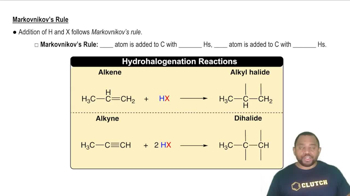
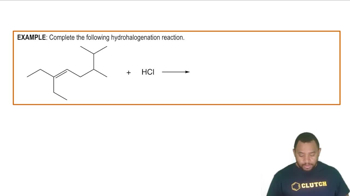
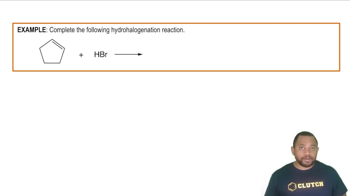
    A reaction where hydrogen and a halogen are added across a pi bond of an alkene or alkyne.
  • Alkene
    A hydrocarbon containing a carbon-carbon double bond.
  • Alkyne
    A hydrocarbon containing a carbon-carbon triple bond.
  • Alkyl Halide
    A compound formed when a halogen is added to an alkane, alkene, or alkyne.
  • Markovnikov's Rule
    A rule stating that hydrogen adds to the carbon with more hydrogens in unsymmetrical alkenes or alkynes.
  • Pi Bond
    A type of covalent bond formed by the sideways overlap of atomic orbitals.
  • Symmetrical Molecule
    A molecule where substituents are evenly distributed, allowing equal addition of atoms.
  • Dihalide
    A compound with two halogen atoms added to the same carbon.
  • Hydrogen
    The lightest and most abundant element, often added in hydrohalogenation reactions.
  • Halogen
    A group 17 element, such as bromine or chlorine, used in hydrohalogenation.
  • Bromine
    A halogen element commonly used in hydrohalogenation reactions.
  • Chlorine
    A halogen element often used in hydrohalogenation reactions.
  • Double Bond
    A chemical bond where two pairs of electrons are shared between atoms.
  • Triple Bond
    A chemical bond where three pairs of electrons are shared between atoms.
  • Mole
    A unit of measurement for amount of substance, used to quantify reactants in reactions.