Which of the following exhibits dipole-dipole intermolecular forces in a pure substance?
A polar molecule, such as HCl, exhibits dipole-dipole intermolecular forces in a pure substance.
Which reason best explains why metals are shiny?
Metals are shiny because their electrons are delocalized, allowing them to reflect light efficiently.
Which intermolecular force is the strongest?
Ion-dipole forces are the strongest intermolecular forces.
Which of the following substances would have the greatest dispersion forces?
A large, heavy, and easily polarizable molecule, such as I2, would have the greatest dispersion forces.
Which of the following allows oil and water to mix or emulsify by reducing surface tension?
Surfactants or emulsifiers allow oil and water to mix by reducing surface tension.
Which of the following most likely requires intermolecular forces?
The condensation of a gas into a liquid most likely requires intermolecular forces.
What intermolecular forces are present between two molecules of HI?
HI molecules experience dipole-dipole forces and London dispersion forces.
Which property typically indicates strong intermolecular forces are present in a liquid?
A high boiling point typically indicates strong intermolecular forces in a liquid.
Which of the following best describes particles in a solid?
Particles in a solid are closely packed and held together by strong intermolecular forces.
Both intra- and intermolecular forces are considered what kind of attraction?
Both are considered electrostatic attractions.
What intermolecular forces are present in each of the substances?
Each substance may have London dispersion, dipole-dipole, hydrogen bonding, or ion-dipole forces depending on its polarity and composition.
Which of the following is not an intermolecular force?
Covalent bonds are not intermolecular forces; they are intramolecular.
Why are metals malleable?
Metals are malleable because their atoms can slide past each other due to the delocalized electrons.
Which term identifies a type of intermolecular force?
Hydrogen bonding identifies a type of intermolecular force.
What causes surface tension?
Surface tension is caused by strong intermolecular forces at the surface of a liquid.
Why don't oil and water mix?
Oil and water do not mix because oil is nonpolar and water is polar, so their intermolecular forces are incompatible.
Which is the strongest intermolecular force?
Ion-dipole force is the strongest intermolecular force.
Why does water have a high surface tension?
Water has high surface tension due to strong hydrogen bonding between its molecules.
Why don’t oil and water mix?
Oil and water do not mix because oil is nonpolar and water is polar, preventing strong intermolecular interactions.
Which one of the following would have the largest dispersion forces?
A molecule with a large number of electrons and a large size, such as I2, would have the largest dispersion forces.
Which is an intermolecular force?
Dipole-dipole interaction is an intermolecular force.
Which feature of water molecules causes them to be attracted to each other?
The polarity of water molecules and hydrogen bonding cause them to be attracted to each other.
What type of intermolecular force occurs between all substances?
London dispersion forces occur between all substances.
What types of intermolecular forces are present in each molecule?
Depending on the molecule, it may have London dispersion, dipole-dipole, hydrogen bonding, or ion-dipole forces.
Which of the following molecules can form hydrogen bonds?
Molecules with hydrogen directly bonded to F, O, or N can form hydrogen bonds.
Which of the following can form hydrogen bonds in a pure sample?
Water (H2O), ammonia (NH3), and hydrogen fluoride (HF) can form hydrogen bonds in a pure sample.
Which of the following compounds would have the highest boiling point?
A compound with strong hydrogen bonding, such as H2O, would have the highest boiling point.
What intermolecular forces are present in pure samples of both CH3CH2OH and CH3CH2NH2?
Both have hydrogen bonding, dipole-dipole, and London dispersion forces.
Which compound has the strongest intermolecular forces?
An ionic compound dissolved in water has the strongest intermolecular forces (ion-dipole).
Which of the following compounds would experience the strongest overall intermolecular forces?
A compound with ion-dipole interactions, such as NaCl in water, would experience the strongest overall intermolecular forces.
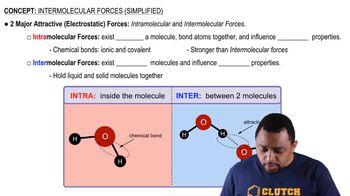
Does intermolecular happen within the same molecule or with two or more separate molecules?
Intermolecular forces occur between two or more separate molecules.
Why is a hydrogen atom in one H2O molecule attracted to the oxygen atom in an adjacent H2O molecule?
Because of hydrogen bonding due to the polarity of water molecules.
Why does water bead up on a freshly waxed car?
Water beads up due to high surface tension from hydrogen bonding, and the wax is nonpolar, preventing spreading.
Which of the following compounds cannot form hydrogen bonds with water?
Nonpolar molecules like CH4 cannot form hydrogen bonds with water.
Which intermolecular force is present in all molecules and atoms?
London dispersion forces are present in all molecules and atoms.
What type(s) of attractive forces exist between all molecules?
London dispersion forces exist between all molecules.
What is the strongest intermolecular force present in the interaction of two molecules of BH3?
London dispersion forces are the strongest present between BH3 molecules.
What is the strongest intermolecular force possible between molecules of the following structure?
The strongest possible force depends on the structure; if it has H bonded to F, O, or N, hydrogen bonding is strongest; otherwise, dipole-dipole or dispersion.
Which type of intermolecular force is stronger?
Ion-dipole forces are stronger than hydrogen bonding, dipole-dipole, and dispersion forces.
What are the three types of intermolecular forces?
The three main types are hydrogen bonding, dipole-dipole, and London dispersion forces.