Which variable(s) does the internal energy of an ideal gas depend upon?
The internal energy of an ideal gas depends only on its temperature, as it is determined by the total kinetic energy of the gas particles.
How do you calculate the change in internal energy of a system?
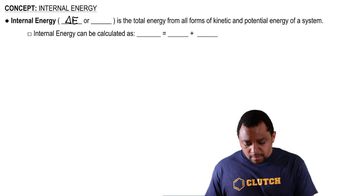
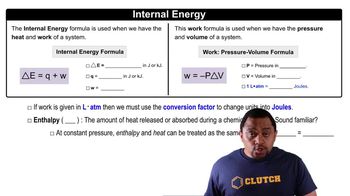
The change in internal energy (ΔE) of a system is calculated using the formula ΔE = Q + W, where Q is the heat added to the system and W is the work done on the system.
What are the two common symbols used to represent internal energy in chemistry?
Internal energy is commonly represented by either ΔE or ΔU.
In what units can internal energy, heat, and work be expressed?
Internal energy, heat, and work can be expressed in joules or kilojoules.
What is the formula for calculating work done by or on a system involving pressure and volume?
Work is calculated using the formula W = -PΔV, where P is pressure and ΔV is the change in volume.
What is the conversion factor from liters-atmospheres to joules for work calculations?
The conversion factor is 101.325 joules per liter-atmosphere.
When is enthalpy (ΔH) equal to the heat (Q) in a chemical reaction?
Enthalpy is equal to heat at constant pressure, so ΔH = Q under these conditions.
What does the variable Q represent in the internal energy equation?
Q represents the heat added to or released from the system.
What does the negative sign in the work formula W = -PΔV indicate?
The negative sign indicates that work is done by the system when it expands (ΔV is positive).
Why is it important to memorize the formulas for internal energy and work in chemistry?
These formulas are essential for solving problems and are often required for quizzes and exams.