Intro to Electrochemical Cells definitions Flashcards

Intro to Electrochemical Cells definitions
Control buttons has been changed to "navigation" mode.
1/14
  • Electrochemical Cell
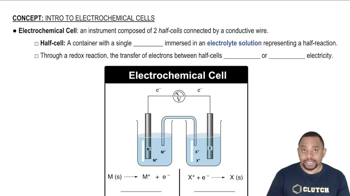
    A device with two half-cells connected by a wire, facilitating redox reactions to produce or consume electricity.
  • Half Cell
    A container with an electrode immersed in an electrolyte, representing a half-reaction in an electrochemical cell.
  • Electrode
    A metal rod in a half-cell where oxidation or reduction occurs, facilitating electron transfer.
  • Electrolyte
    A solution in which the electrode is immersed, allowing ions to move and participate in redox reactions.
  • Redox Reaction
    A chemical process involving the transfer of electrons, comprising oxidation and reduction.
  • Oxidation
    A process where an element loses electrons, increasing its oxidation state.
  • Reduction
    A process where an element gains electrons, decreasing its oxidation state.
  • Cell Potential
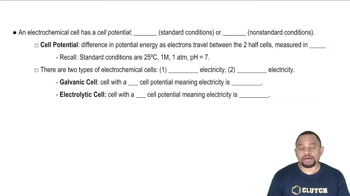
    The energy difference measured in volts as electrons move between half-cells in an electrochemical cell.
  • Standard Conditions
    Conditions of 25°C, 1 M concentration, 1 atm pressure, and pH 7 used to measure standard cell potential.
  • Standard Cell Potential
    The cell potential measured under standard conditions, indicating the energy difference in a redox reaction.
  • Non-standard Cell Potential
    The cell potential measured under conditions differing from standard, affecting the energy difference.
  • Galvanic Cell
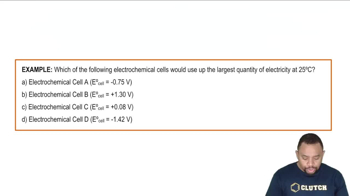
    An electrochemical cell with a positive cell potential, producing electricity.
  • Electrolytic Cell
    An electrochemical cell with a negative cell potential, consuming electricity.
  • Volts
    The unit of measurement for cell potential, indicating the energy difference in an electrochemical cell.