Back

Kinetic Molecular Theory quiz

Control buttons has been changed to "navigation" mode.
1/15
  • What is an ideal gas according to the kinetic molecular theory?

    An ideal gas is a hypothetical gas that behaves as if it is alone, unaffected by other gases, and follows specific postulates.
  • How does the kinetic molecular theory help us understand real gases?

    It uses data from real gases to predict how ideal gases would behave if they existed.
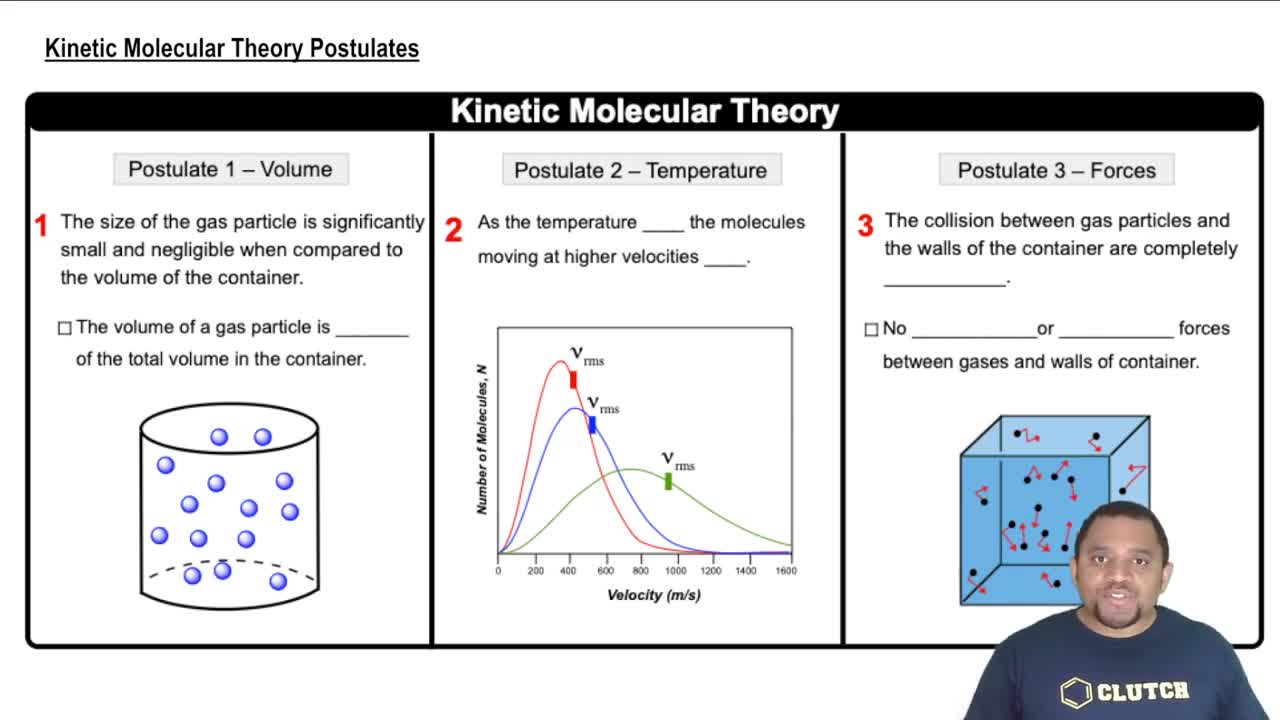
  • What is the first postulate of the kinetic molecular theory?

    The volume of gas particles is negligible compared to the volume of the container.
  • How much space do gas particles occupy in a container according to postulate 1?

    Gas particles occupy less than 0.01% of the total container volume.
  • What does postulate 2 of the kinetic molecular theory state about temperature?

    As temperature increases, the velocity of gas molecules also increases.
  • What is root mean square speed in the context of kinetic molecular theory?

    It is a measure of the average speed of gas molecules at a given temperature.
  • How does temperature affect the root mean square speed of gas molecules?

    Higher temperatures result in higher root mean square speeds for gas molecules.
  • What is the third postulate of the kinetic molecular theory?

    Collisions between gas particles and container walls are completely elastic.
  • What does it mean for gas particle collisions to be elastic?

    Elastic collisions mean there are no attractive or repulsive forces between gas particles or with the container walls.
  • How do ideal gas particles behave during collisions according to the theory?

    They bounce off each other and the walls without sticking together or repelling each other.
  • Why are ideal gases considered imaginary?

    Because they assume no interactions and negligible volume, which does not occur in real gases.
  • How do real gases differ from ideal gases in a container?

    Real gases interact with each other and can affect each other's trajectories, unlike ideal gases.
  • What analogy is used to describe elastic collisions in the kinetic molecular theory?

    Elastic collisions are compared to ping pong balls bouncing in a container.
  • Why is the kinetic molecular theory useful despite ideal gases not existing?

    It helps predict and understand the behavior of real gases by applying ideal gas principles.
  • What happens to gas molecules at higher temperatures according to the kinetic molecular theory?

    They move at higher velocities, increasing their speed as temperature rises.