Skip to main content
General Chemistry
My Course
Learn
Exam Prep
AI Tutor
Study Guides
Textbook Solutions
Flashcards
Explore
Try the app
My Course
Learn
Exam Prep
AI Tutor
Study Guides
Textbook Solutions
Flashcards
Explore
Try the app
Back
Kp and Kc definitions
You can tap to flip the card.
Equilibrium Constant
You can tap to flip the card.
👆
Equilibrium Constant
A value representing the ratio of product concentrations to reactant concentrations at equilibrium.
Track progress
Control buttons has been changed to "navigation" mode.
1/15
Related flashcards
Related practice
Recommended videos
Kp and Kc quiz #1
Kp and Kc
10 Terms
Kp and Kc quiz
Kp and Kc
15 Terms
Kp and Kc
16. Chemical Equilibrium
6 problems
Topic
Jules
Using Hess's Law To Determine K
16. Chemical Equilibrium
3 problems
Topic
ErnestBlazevic
16. Chemical Equilibrium - Part 1 of 2
5 topics
13 problems
Chapter
Jules
16. Chemical Equilibrium - Part 2 of 2
5 topics
13 problems
Chapter
Jules
Guided course
02:06
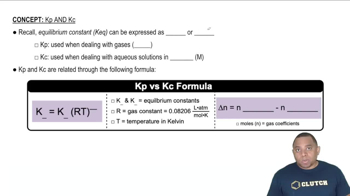
Kp vs. Kc Formula
5657
views
60
rank
2
comments
Guided course
02:31
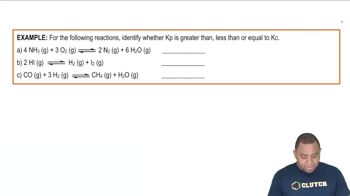
Kp vs Kc Relationship Example
3415
views
38
rank
1
comments
Guided course
02:18
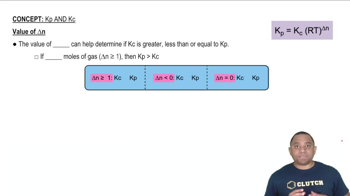
Kp vs Kc Relationship
4018
views
34
rank
1
comments
Terms in this set (15)
Hide definitions
Equilibrium Constant
A value representing the ratio of product concentrations to reactant concentrations at equilibrium.
Kp
The equilibrium constant for gaseous reactions, expressed in terms of partial pressures.
Kc
The equilibrium constant for reactions in solution, expressed in terms of molarity.
Molarity
A concentration unit defined as moles of solute per liter of solution.
Gas Constant
A constant used in equations involving gases, typically 0.08206 L·atm/mol·K.
Kelvin
The SI unit for temperature, used in thermodynamic equations.
Δn
The change in moles of gas, calculated as moles of products minus moles of reactants.
Partial Pressure
The pressure exerted by a single gas in a mixture of gases.
Balanced Equation
A chemical equation with equal numbers of each type of atom on both sides.
Reversible Reaction
A chemical reaction that can proceed in both forward and reverse directions.
Products
Substances formed as a result of a chemical reaction.
Reactants
Substances consumed during a chemical reaction.
Atmospheres
A unit of pressure used in expressing gas pressures.
Coefficients
Numbers in a chemical equation indicating the relative amounts of reactants and products.
Chemical Equilibrium
The state in which the concentrations of reactants and products remain constant over time.
 BackBack

 02:06
02:06