Law of Definite Proportions quiz #1 Flashcards

Law of Definite Proportions quiz #1
Control buttons has been changed to "navigation" mode.
1/10
  • Which term represents the fixed proportion of elements in a compound according to the Law of Definite Proportions?
    The term is 'mass ratio,' which refers to the constant proportion by mass of each element in a chemical compound.
  • Which substance contains elements chemically combined in a fixed proportion by mass?
    A chemical compound contains elements chemically combined in a fixed proportion by mass.
  • What is formed when two or more atoms combine chemically in definite proportions by mass?
    A chemical compound is formed when two or more atoms combine chemically in definite proportions by mass.
  • Who originated the Law of Definite Proportions and in what year?
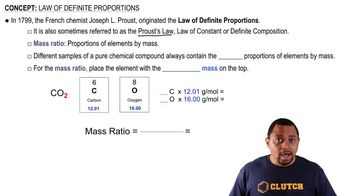
    Joseph L. Proust originated the Law of Definite Proportions in 1799.
  • What is another name for the Law of Definite Proportions?
    It is also known as Proust's Law or the Law of Constant Composition.
  • How do you determine which element's mass goes on top when calculating a mass ratio for a compound?
    The element with the larger mass contribution is placed on top when calculating the mass ratio.
  • What does a mass ratio of 2.66 for CO2 indicate?
    It indicates that there are 2.66 grams of oxygen for every 1 gram of carbon in carbon dioxide.
  • How can the Law of Definite Proportions help identify if two samples are the same compound?
    By comparing their mass ratios; if the ratios are identical, the samples are the same compound.
  • What atomic masses are used to calculate the mass ratio in CO2?
    The atomic masses used are 12.01 g/mol for carbon and 16 g/mol for oxygen.
  • Why is the Law of Definite Proportions important in chemical analysis?
    It allows chemists to verify the identity of compounds by ensuring their elemental mass ratios are constant.