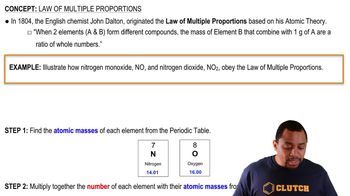
Which of the following pairs of compounds is an example of the law of multiple proportions?
Nitrogen monoxide (NO) and nitrogen dioxide (NO2) are an example of the law of multiple proportions, as they show that nitrogen and oxygen combine in simple whole number ratios to form different compounds.
Which pair of substances could be used to illustrate the law of multiple proportions?
The pair nitrogen monoxide (NO) and nitrogen dioxide (NO2) can be used to illustrate the law of multiple proportions, since they demonstrate how the same elements (nitrogen and oxygen) combine in different whole number ratios.
Who formulated the Law of Multiple Proportions and in what year?
John Dalton formulated the Law of Multiple Proportions in 1804.
What is the first step in determining if two compounds obey the Law of Multiple Proportions?
The first step is to find the atomic masses of each element from the periodic table.
How do you calculate the mass ratio for a compound like nitrogen monoxide (NO)?
Multiply the number of atoms of each element by their atomic masses and divide the mass of oxygen by the mass of nitrogen.
What is the mass ratio of oxygen to nitrogen in nitrogen dioxide (NO2)?
The mass ratio is 32 grams of oxygen to 14.01 grams of nitrogen, which equals approximately 2.28.
Why do you divide the larger mass ratio by the smaller one when applying the Law of Multiple Proportions?
Dividing the larger mass ratio by the smaller one checks if the result is a whole number, confirming the law is obeyed.
What does a whole number result indicate when comparing mass ratios of two compounds?
A whole number result indicates that the compounds obey the Law of Multiple Proportions.
In the example of NO and NO2, what is the ratio obtained when dividing their mass ratios?
The ratio obtained is 2, showing a simple whole number relationship.
What is the atomic mass of nitrogen and oxygen used in the calculations for NO and NO2?
Nitrogen is 14.01 grams per mole and oxygen is 16 grams per mole.