What are the solutions to the equation n^2 - 49 = 0?
The solutions are n = 7 and n = -7, since n^2 = 49.
What is an expression that uses a base and an exponent called?
An expression using a base and an exponent is called a power or exponential expression.
What is the solution to the equation x^3 = 27?
The solution is x = 3, since 3^3 = 27.
What are the solutions to the equation x^2 = 169?
The solutions are x = 13 and x = -13, since both (13)^2 and (-13)^2 equal 169.
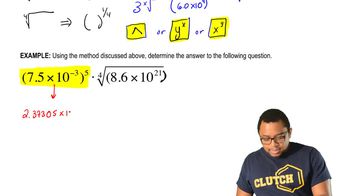
What must you do to the coefficient when raising a number in scientific notation to a power?
You raise the coefficient to that power. This means multiplying the coefficient by itself as many times as the power indicates.
How do you adjust the exponent when raising a scientific notation number to a power?
You multiply the original exponent by the power. This gives you the new exponent for the result.
Why must the coefficient in scientific notation be between 1 and 10 after calculations?
Scientific notation requires the coefficient to be between 1 and 10 for standard form. If it is not, you must adjust the coefficient and exponent accordingly.
What mathematical operation is equivalent to taking the nth root of a number?
Taking the nth root is the same as raising the number to the 1/n power. This applies to both the coefficient and the exponent in scientific notation.
How do you calculate the new exponent when taking the nth root of a number in scientific notation?
You multiply the original exponent by the reciprocal of n (1/n). This gives you the new exponent for the result.
What are two common calculator methods for finding roots or fractional powers?
One method uses a root button (like x√y), and the other uses a power button (like y^x or x^y) with a fractional exponent. Both methods can achieve the same result if used correctly.
 Back
Back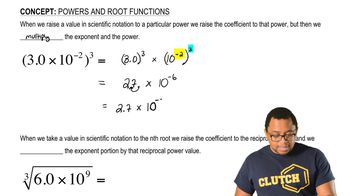
 04:42
04:42