Skip to main content
General Chemistry
My Course
Learn
Exam Prep
AI Tutor
Study Guides
Textbook Solutions
Flashcards
Explore
Try the app
My Course
Learn
Exam Prep
AI Tutor
Study Guides
Textbook Solutions
Flashcards
Explore
Try the app
Back
Types of Aqueous Solutions definitions
You can tap to flip the card.
Solution Equilibrium
You can tap to flip the card.
👆
Solution Equilibrium
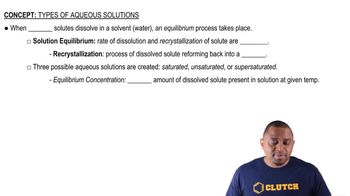
A state where the rates of solute dissolution and recrystallization are equal.
Track progress
Control buttons has been changed to "navigation" mode.
1/12
Related flashcards
Related practice
Recommended videos
Types of Aqueous Solutions quiz #1
Types of Aqueous Solutions
18 Terms
Types of Aqueous Solutions quiz
Types of Aqueous Solutions
15 Terms
Types of Aqueous Solutions
14. Solutions
5 problems
Topic
Jules
Intro to Henry's Law
14. Solutions
4 problems
Topic
Jules
14. Solutions - Part 1 of 3
4 topics
12 problems
Chapter
Jules
14. Solutions - Part 2 of 3
5 topics
12 problems
Chapter
Jules
14. Solutions - Part 3 of 3
5 topics
12 problems
Chapter
Jules
Guided course
01:49
Types of Aqueous Solution Example
4520
views
20
rank
Guided course
01:11
Types of Aqueous Solutions
5064
views
40
rank
Guided course
03:20
Different Types of Aqueous Solutions
4647
views
35
rank
2
comments
Terms in this set (12)
Hide definitions
Solution Equilibrium
A state where the rates of solute dissolution and recrystallization are equal.
Dissolution
The process where a solid solute breaks into ions in a solvent.
Recrystallization
The process where dissolved solute reforms into a solid.
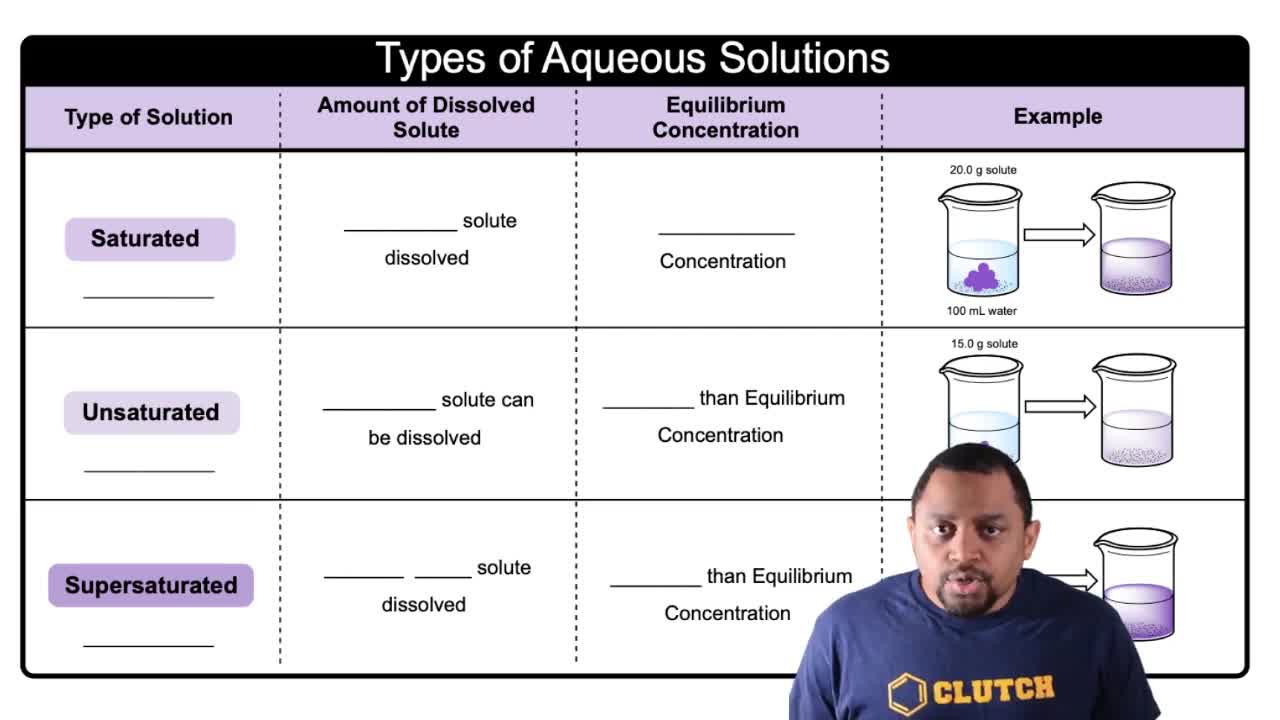
Saturated Solution
A stable solution with the maximum amount of solute dissolved at equilibrium.
Unsaturated Solution
A stable solution that can dissolve more solute, below equilibrium concentration.
Supersaturated Solution
An unstable solution with more solute than equilibrium allows, often requiring heat.
Equilibrium Concentration
The maximum solute concentration in a solution at a given temperature.
Homogeneous Mixture
A mixture with uniform composition throughout, such as a solution.
Solute
The substance dissolved in a solvent to form a solution.
Solvent
The substance in which a solute is dissolved to form a solution.
Temperature
A factor that can increase solubility, affecting solution saturation.
Solubility
The ability of a solute to dissolve in a solvent at a specific temperature.
 BackBack
 01:49
01:49