Back

Molecular Formula quiz

Control buttons has been changed to "navigation" mode.
1/15
  • What does the molecular formula of a compound represent?

    The molecular formula shows the actual number of atoms of each element in a compound.
  • What does the empirical formula of a compound represent?

    The empirical formula shows the simplest whole-number ratio of elements in a compound.
  • How do you convert an empirical formula to a molecular formula if you know the n factor?

    Multiply each subscript in the empirical formula by the n factor to get the molecular formula.
  • What is the n factor in the context of molecular formulas?

    The n factor is a number used to multiply the empirical formula's subscripts to obtain the molecular formula.
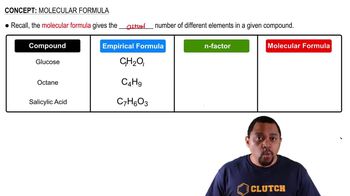
  • What is the molecular formula of glucose if its empirical formula is CH2O and n factor is 6?

    The molecular formula is C6H12O6.
  • What is the molecular formula of octane if its empirical formula is C4H9 and n factor is 2?

    The molecular formula is C8H18.
  • What is the molecular formula of salicylic acid if its empirical formula is C7H6O3 and n factor is 1?

    The molecular formula is C7H6O3.
  • What happens to the molecular formula if the n factor is 1?

    The molecular formula is the same as the empirical formula.
  • What information do you need to determine the n factor if it is not given?

    You need the empirical formula and the molar mass of the compound.
  • Why is it important to know both empirical and molecular formulas?

    Knowing both helps chemists accurately identify the composition and properties of substances.
  • If a compound’s empirical formula is CH2O and its molar mass is 180 g/mol, what is the n factor?

    The n factor is 6, since the molar mass of CH2O is 30 g/mol and 180/30 = 6.
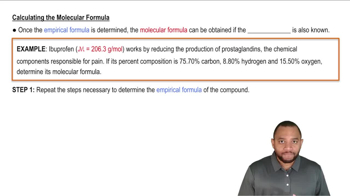
  • How do you calculate the molecular formula if you only have the empirical formula and molar mass?

    Divide the compound’s molar mass by the empirical formula’s molar mass to find the n factor, then multiply the subscripts.
  • What is the first step in determining a compound’s molecular formula when the n factor is unknown?

    First, determine the empirical formula of the compound.
  • What is the relationship between the empirical and molecular formulas for compounds like salicylic acid?

    For salicylic acid, the empirical and molecular formulas are identical because the n factor is 1.
  • What do you multiply to get the molecular formula from the empirical formula?

    Multiply the subscripts of the empirical formula by the n factor.