Back

Naming Acids quiz

Control buttons has been changed to "navigation" mode.
1/15
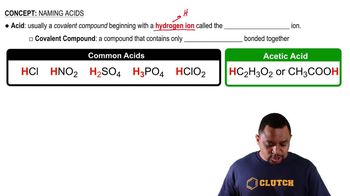
  • What is the typical starting ion in an acid compound?

    Acids usually begin with a hydrogen ion (H+), also known as a hydronium ion.
  • What type of elements are found in covalent compounds?

    Covalent compounds contain only nonmetals bonded together.
  • What is an exception to the rule that acids start with hydrogen?

    Acetic acid can be written with the hydrogen ion at the end, as in CH3COOH.
  • What is a binary acid?

    A binary acid is a covalent compound with hydrogen bonded to a nonmetal anion, excluding oxygen.
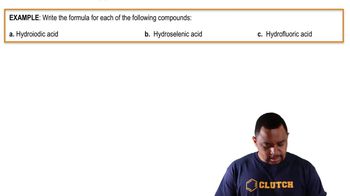
  • What prefix is used when naming binary acids?

    The prefix 'hydro-' is used to represent the hydrogen ion in binary acids.
  • How do you determine the base name for the nonmetal in a binary acid?

    Use the base name of the nonmetal, except for sulfur and phosphorus, where more of the name is used.
  • What suffix is added to the name of a binary acid?

    The suffix 'ic acid' is added to the end of the binary acid name.
  • What is an oxyacid?

    An oxyacid is a covalent compound containing hydrogen ions bonded to a polyatomic ion with oxygen.
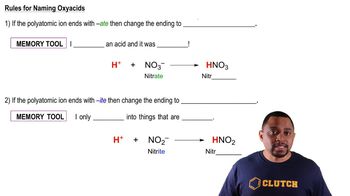
  • How do you name an oxyacid if the polyatomic ion ends in '-ate'?

    Change the ending to '-ic acid' for the acid name.
  • How do you name an oxyacid if the polyatomic ion ends in '-ite'?

    Change the ending to '-ous acid' for the acid name.
  • What is the acid name for HNO3?

    HNO3 is called nitric acid because the nitrate ion ends in '-ate'.
  • What is the acid name for HNO2?

    HNO2 is called nitrous acid because the nitrite ion ends in '-ite'.
  • Why is it important to know polyatomic ions when naming oxyacids?

    Knowing polyatomic ions helps determine the correct acid name based on the ion's ending.
  • What is the memory tool for naming acids with polyatomic ions ending in '-ate'?

    Remember 'I ate in acid and it was icky' to associate '-ate' with '-ic acid'.
  • What is the memory tool for naming acids with polyatomic ions ending in '-ite'?

    Remember 'I only bite into things that are delicious' to associate '-ite' with '-ous acid'.