Carbonic acid is formed in nature when carbon dioxide (CO2) dissolves in water (H2O), resulting in the formation of H2CO3.
How is carbonic acid formed?
Carbonic acid is formed by the reaction of carbon dioxide (CO2) with water (H2O), producing H2CO3.
What is the chemical formula for phosphorous acid?
The formula for phosphorous acid is H3PO3.
What is the chemical formula for hypochlorous acid?
The formula for hypochlorous acid is HClO.
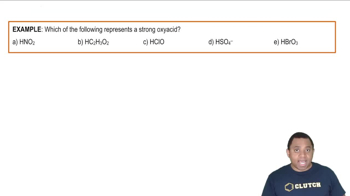
How do you determine if a neutral oxyacid is strong or weak?
A neutral oxyacid is considered strong if it has two or more oxygen atoms than hydrogen atoms, except for oxalic acid (H2C2O4) and iodic acid (HIO3), which are weak due to the low electronegativity of their central elements.
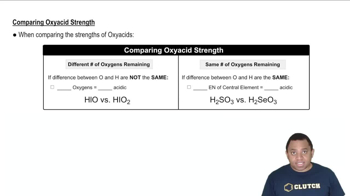
How do you compare the strength of two oxyacids?
To compare the strength of two oxyacids, first subtract the number of hydrogen atoms from the number of oxygen atoms in each acid; the acid with more remaining oxygens is stronger. If the number of remaining oxygens is the same, the acid with the more electronegative central element is stronger.
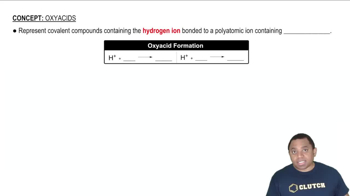
What is the process for determining the chemical formula of an oxyacid formed from a hydrogen ion and a polyatomic ion containing oxygen?
Combine the hydrogen ion (H+) with the polyatomic ion, crisscrossing the numbers if their charges differ, to form the oxyacid. The resulting formula will begin with hydrogen and include the polyatomic ion containing oxygen.