Percent Yield quiz #1 Flashcards Back You can tap to flip the card.
What factors can cause the percent yield of a chemical reaction to be less than 100%?
You can tap to flip the card. 👆
What factors can cause the percent yield of a chemical reaction to be less than 100%?
Percent yield is less than 100% due to practical limitations such as loss of product during transfer, incomplete reactions, side reactions, or measurement errors.
Control buttons has been changed to "navigation" mode.
1/27 Related flashcards Related practice Recommended videos
What factors can cause the percent yield of a chemical reaction to be less than 100%?
Percent yield is less than 100% due to practical limitations such as loss of product during transfer, incomplete reactions, side reactions, or measurement errors. What is the term for the error in a measurement expressed as a percentage of the accepted value?
Percent error is the term for error expressed as a percentage of the accepted value. What is the formula for percent error in chemistry?
Percent error = [(experimental value - accepted value) / accepted value] × 100. What is the measure of the efficiency of a chemical reaction called?
The efficiency of a chemical reaction is measured by percent yield. How do you calculate percent error?
Percent error is calculated as [(experimental value - accepted value) / accepted value] × 100. If 8.88 g of Fe was obtained in a reaction, what is the percent yield of Fe if the theoretical yield is known?
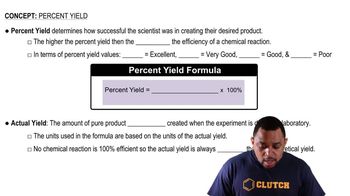
Percent yield = (actual yield / theoretical yield) × 100; substitute 8.88 g for actual yield and the given theoretical yield. What does percent yield indicate in a chemical reaction?
Percent yield indicates how successful and efficient a chemical reaction was in producing the desired product. Which of the following factors would reduce the yield of a chemical reaction?
Factors such as incomplete reactions, loss of product, side reactions, and measurement errors reduce the yield. Which of the following is not a reason why actual yield is less than theoretical yield?
Obtaining more product than theoretically possible is not a reason; actual yield is always less due to practical limitations. What is the difference between theoretical yield and actual yield in a chemical reaction?
Theoretical yield is the maximum predicted product from calculations; actual yield is the amount of product actually obtained in the lab. If the theoretical yield is 80.0 g and the percent yield is 95%, what is the actual yield?
Actual yield = (percent yield / 100) × theoretical yield = (95/100) × 80.0 g = 76.0 g. What is the maximum possible amount of product obtained in a chemical reaction called?
The maximum possible amount of product is called the theoretical yield. Which statement correctly describes the actual yield and the theoretical yield of a reaction?
Actual yield is the amount of product obtained experimentally; theoretical yield is the calculated maximum possible product. Which statement correctly describes the relationship between reactant amount and product yield?
The amount of reactant determines the theoretical yield, but actual yield is usually less due to inefficiencies. What is the percent ionization in a 0.300 M solution of formic acid (HCOOH) with Ka = 1.78 × 10⁻⁴?
Percent ionization = ([H⁺] at equilibrium / initial [HCOOH]) × 100; calculate [H⁺] using the Ka expression. If the actual yield of NO is 2.18 g, how do you calculate the percent yield?
Percent yield = (actual yield / theoretical yield) × 100; use 2.18 g as the actual yield. What is the percent yield of HCl if 42.0 g of HCl are produced from the reaction of 62.0 g of PCl3 and the theoretical yield is known?
Percent yield = (actual yield / theoretical yield) × 100; substitute 42.0 g for actual yield and the calculated theoretical yield. If 32.5 g of Zn is produced in a reaction, how do you determine the percent yield?
Percent yield = (actual yield / theoretical yield) × 100; use 32.5 g as the actual yield. How do you find the theoretical yield in a chemical reaction?
Calculate the theoretical yield using stoichiometry based on the limiting reactant and balanced chemical equation. What is percent recovery in a chemical process?
Percent recovery is the ratio of the amount of purified product obtained to the original amount, expressed as a percentage. How do you find the theoretical yield in a chemical reaction?
Use stoichiometric calculations from the balanced equation and limiting reactant to determine the maximum possible product. How do you find the actual yield in a chemical reaction?
Actual yield is the measured amount of product obtained from the experiment. How do you calculate theoretical yield in a chemical reaction?
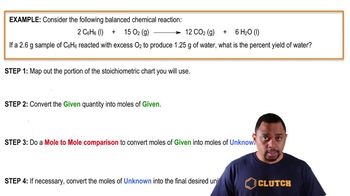
Calculate theoretical yield by converting reactant amounts to moles, using stoichiometry, and converting to desired units. How do you get the theoretical yield in a chemical reaction?
Determine the limiting reactant, use stoichiometry, and calculate the maximum amount of product possible. When studying the yield of a chemical process, what is the key measurement for efficiency?
Percent yield is the key measurement for efficiency in a chemical process. How is the percent of acetic acid in commercial vinegar analyzed?
Percent of acetic acid is determined by titration and calculation based on the amount of acid neutralized. How do you calculate the theoretical yield in a chemical reaction?
Use stoichiometry and the limiting reactant to calculate the maximum possible amount of product.