Back

Periodic Table: Charges quiz

Control buttons has been changed to "navigation" mode.
1/15
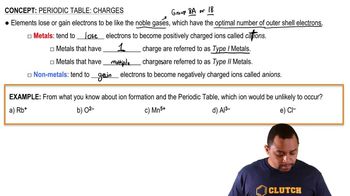
  • Why do elements lose or gain electrons according to the periodic table?

    Elements lose or gain electrons to achieve the same number of electrons as the nearest noble gas, resulting in a stable outer shell.
  • What type of ions do metals typically form and why?

    Metals typically form positively charged ions called cations because they lose electrons.
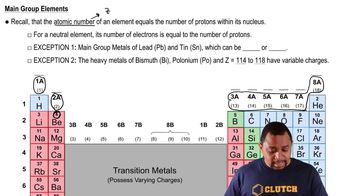
  • What is the charge of ions formed by group 1A metals?

    Group 1A metals form ions with a +1 charge.
  • What is the typical charge for ions formed by group 2A metals?

    Group 2A metals form ions with a +2 charge.
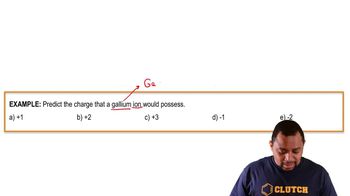
  • What charge do group 3A metals usually have when they form ions?

    Group 3A metals usually form ions with a +3 charge.
  • How do nonmetals generally achieve a noble gas configuration?

    Nonmetals gain electrons to become negatively charged ions called anions.
  • What is the typical charge for ions formed by group 7A nonmetals?

    Group 7A nonmetals form ions with a -1 charge.
  • What charge do group 6A nonmetals usually have as ions?

    Group 6A nonmetals usually form ions with a -2 charge.
  • What is the common charge for group 5A nonmetal ions?

    Group 5A nonmetals commonly form ions with a -3 charge.
  • Why are noble gases generally unreactive in terms of ion formation?

    Noble gases are unreactive because they already have a full outer shell and do not need to gain or lose electrons, so their charge is 0.
  • What is unique about the charges of transition metals compared to main group metals?

    Transition metals can have multiple possible positive charges due to their electron arrangements, unlike main group metals which usually have only one.
  • What are type 2 metals and which elements are typically included?

    Type 2 metals are metals that can have multiple charges, and most transition metals fall into this category.
  • Which transition metals have only one stable charge and what are those charges?

    Scandium is always +3, silver is always +1, and both cadmium and zinc are always +2.
  • Why is group 4A considered 'not applicable' for standard ion charges?

    Group 4A elements can either gain or lose 4 electrons, making their charge assignment ambiguous, so it's considered not applicable.
  • What is special about the charges of tin (Sn) and lead (Pb)?

    Tin and lead can have charges of either +2 or +4, showing behavior similar to transition metals.