Back

Periodic Table: Group Names quiz

Control buttons has been changed to "navigation" mode.
1/15
  • What are the horizontal rows on the periodic table called?

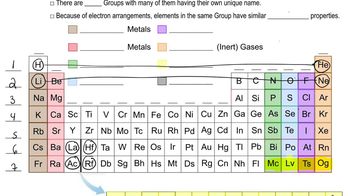
    The horizontal rows are called periods. There are currently seven periods on the periodic table.
  • How many vertical groups are there in the periodic table?

    There are 18 vertical groups, also known as columns, families, or series.
  • What is the main reason elements in the same group have similar chemical properties?

    Elements in the same group have similar chemical properties due to their electron arrangements. This similarity is foundational in understanding their behavior.
  • What is the special name for Group 1 elements?

    Group 1 elements are called alkali metals. They include lithium through francium.
  • What is the special name for Group 2 elements?

    Group 2 elements are called alkaline earth metals. They include beryllium through radium.
  • What is the name given to Group 15 elements?

    Group 15 elements are called pnictogens. They include nitrogen through moscovium.
  • What is the name given to Group 16 elements?

    Group 16 elements are called chalcogens. They include oxygen through livermorium.
  • What is the name given to Group 17 elements?

    Group 17 elements are called halogens. They include fluorine through tennessine.
  • What is the name given to Group 18 elements?

    Group 18 elements are called noble gases or inert gases. They include helium through oganesson.
  • Why were Group 18 elements originally called inert gases?

    They were believed to be so stable that nothing would react with them. Later, it was found that some do form compounds, so the term 'noble gases' is now preferred.
  • What are the two rows placed separately at the bottom of the periodic table called?

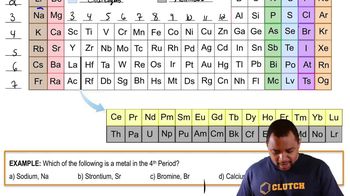
    The two rows are called lanthanides and actinides. Lanthanides follow lanthanum, and actinides follow actinium.
  • Why are the lanthanides and actinides placed at the bottom of the periodic table?

    They are placed at the bottom to make the periodic table more presentable. These rows actually fit between certain elements in the main table.
  • Is the periodic table static or dynamic, and what does that mean?

    The periodic table is dynamic, meaning it can change as new elements are discovered or synthesized. This could lead to more periods being added in the future.
  • What is another term used for groups in the periodic table?

    Groups are also called families or series. These terms refer to the vertical columns.
  • How are periods and groups arranged on the periodic table?

    Periods are horizontal rows, and groups are vertical columns. This arrangement helps organize elements by their properties.