Periodic Trend: Atomic Radius quiz #1 Flashcards

Periodic Trend: Atomic Radius quiz #1
Control buttons has been changed to "navigation" mode.
1/40
  • Which element has the smallest atomic radius?
    Helium has the smallest atomic radius among all elements.
  • Which element has a larger atomic radius than sulfur: chlorine, cadmium, fluorine, or oxygen?
    Cadmium has a larger atomic radius than sulfur.
  • Which is an observed trend in atomic radii?
    Atomic radius increases down a group and decreases across a period from left to right.
  • Which factor would be most likely to shrink the size of an atom’s electron cloud?
    Increasing the attraction between the nucleus and electrons, such as by increasing nuclear charge, shrinks the electron cloud.
  • Which element has a larger atomic radius than sulfur?
    Elements below sulfur in the same group, such as selenium, have a larger atomic radius.
  • Which of the following transition metals would be predicted to have the smallest atomic radius?
    Transition metals further to the right in a period, such as nickel, generally have smaller atomic radii.
  • Why does the atomic radius increase as you go from the top to the bottom of a chemical family?
    Atomic radius increases down a family because additional electron shells are added.
  • Which of these elements has the smallest atomic radius?
    Fluorine has the smallest atomic radius among the options typically given.
  • What do elements in the same period have in common?
    Elements in the same period have the same number of electron shells.
  • Which atom or ion is the largest?
    Neutral atoms are generally larger than their cations; for example, K is larger than K+.
  • What element is theoretically the largest of all on the periodic table?
    Francium is considered to have the largest atomic radius among naturally occurring elements.
  • How does atomic radius change from top to bottom in a group in the periodic table?
    Atomic radius increases from top to bottom in a group.
  • Which are reasons for atomic radii decreasing across a period?
    Increasing nuclear charge pulls electrons closer, decreasing atomic radius across a period.
  • How does atomic radius change as you go down a group?
    Atomic radius increases as you go down a group.
  • What is the trend in atomic size as you proceed down a group?
    Atomic size increases as you proceed down a group.
  • Which of the following has the smallest atomic radius?
    Helium has the smallest atomic radius among all elements.
  • Which general trend is observed as the elements in period 2 are considered from left to right?
    Atomic radius decreases from left to right across period 2.
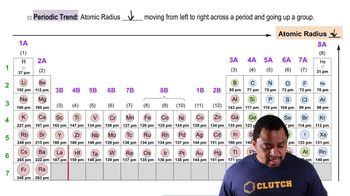
  • Each element has three numbers listed under it. Which value represents the atomic radius?
    The value given in picometers (pm) represents the atomic radius.
  • What happens to the radius as you move across a period?
    Atomic radius decreases as you move across a period from left to right.
  • What element in the second period has the largest atomic radius?
    Lithium has the largest atomic radius in the second period.
  • Why does the atomic radius decrease as you go to the right?
    Increasing nuclear charge pulls electrons closer, decreasing atomic radius.
  • What trend in atomic radius do you see as you go down a group/family on the periodic table?
    Atomic radius increases as you go down a group.
  • How do you think the size of atoms will change from top to bottom within a chemical family?
    Atoms get larger from top to bottom within a chemical family.
  • How does atomic radius change from top to bottom within a group?
    Atomic radius increases from top to bottom within a group.
  • How does the atomic radius of different elements change across a period?
    Atomic radius decreases across a period from left to right.
  • What is the trend in atomic radii as you move from left-to-right across a period?
    Atomic radii decrease from left to right across a period.
  • Which of the following list of elements is arranged from smallest to largest atomic radius?
    Elements arranged from smallest to largest atomic radius: F, O, S, Na, K.
  • What trend in size of the atom do you see as you move across a period?
    Atomic size decreases as you move across a period.
  • Which periodic group has the smallest atomic radius?
    Group 18 (noble gases) generally have the smallest atomic radii in their respective periods.
  • What happens to the atomic radius as you move across a period from left to right?
    Atomic radius decreases as you move from left to right across a period.
  • How does the atomic radius change across a period of the periodic table?
    Atomic radius decreases across a period.
  • What trend in size of the atom do you see as you move down a group?
    Atomic size increases as you move down a group.
  • What is the trend in atomic radius from left to right across a period?
    Atomic radius decreases from left to right across a period.
  • What happens to the radius as you move down group 1?
    Atomic radius increases as you move down group 1.
  • Why does atomic radius decrease across a period?
    Increasing nuclear charge pulls electrons closer, decreasing atomic radius.
  • Which statement best explains why calcium has a larger atomic radius than magnesium?
    Calcium has more electron shells than magnesium, making its atomic radius larger.
  • What trend in atomic radius do you see as you go across a period/row on the periodic table?
    Atomic radius decreases as you go across a period.
  • Which of the following has the largest atomic radius?
    Francium has the largest atomic radius among naturally occurring elements.
  • What causes the atomic radius of the elements to decrease across period 3 from left to right?
    Increasing nuclear charge pulls electrons closer, decreasing atomic radius.
  • What happens to the atomic radius as we move down the group?
    Atomic radius increases as we move down the group.