Photoelectric Effect definitions Flashcards

Photoelectric Effect definitions
Control buttons has been changed to "navigation" mode.
1/15
  • Photoelectric Effect
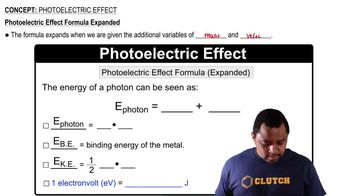
    Phenomenon where photons with sufficient energy eject electrons from a metal surface.
  • Photon
    A particle representing a quantum of light or other electromagnetic radiation.
  • Electron
    A subatomic particle with a negative charge, ejected during the photoelectric effect.
  • Metal Surface
    The material from which electrons are ejected when struck by photons.
  • Binding Energy
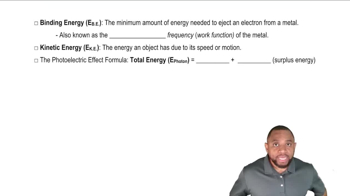
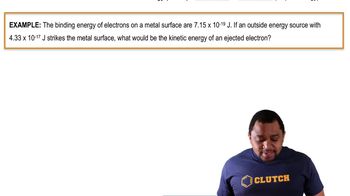
    Minimum energy required to eject an electron from a metal surface.
  • Threshold Frequency
    The minimum frequency of light needed to eject an electron from a metal.
  • Work Function
    The energy needed to remove an electron from a solid to a point in the vacuum.
  • Kinetic Energy
    Energy an object possesses due to its motion, gained by ejected electrons.
  • Planck's Constant
    A fundamental constant used to describe the sizes of quanta, denoted as h.
  • Frequency
    The number of occurrences of a repeating event per unit of time, denoted as mu.
  • Electron Volt
    A unit of energy equal to approximately 1.602 x 10^-19 joules.
  • Joule
    A derived unit of energy in the International System of Units.
  • Mass
    A measure of the amount of matter in an object, used in kinetic energy calculations.
  • Velocity
    The speed of something in a given direction, used in kinetic energy calculations.
  • Energy
    The capacity to do work, involved in the ejection of electrons in the photoelectric effect.