What is the threshold frequency (ν₀) of cesium in the context of the photoelectric effect?
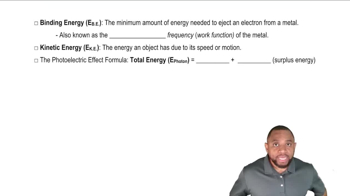
The threshold frequency (ν₀) of cesium is the minimum frequency of incident light required to eject an electron from its surface. It corresponds to the binding energy (work function) of cesium, but the exact value must be determined experimentally or provided in data tables.
In what way does the photoelectric effect support the particle theory of light?
The photoelectric effect supports the particle theory of light by showing that light consists of photons with quantized energy. Only photons with energy above the metal's binding energy can eject electrons, demonstrating that light behaves as particles rather than continuous waves.
What is the best description of Einstein's explanation of the photoelectric effect?
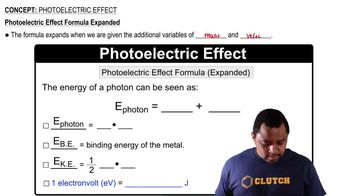
Einstein explained the photoelectric effect by proposing that light is made of photons, each with energy proportional to its frequency. Electrons are ejected from a metal only if the photon energy exceeds the metal's binding energy, with any excess energy becoming the electron's kinetic energy.
What can happen to an electron when sunlight (photons) hits it on a metal surface?
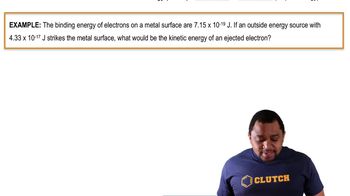
When sunlight (photons) hits an electron on a metal surface, the electron can be ejected if the photon's energy is greater than the metal's binding energy. Any excess energy is converted into the electron's kinetic energy.
Which of the following are by-products of photoelectric absorption?
A by-product of photoelectric absorption is the ejection of electrons from the metal surface, with the electrons gaining kinetic energy equal to the excess photon energy above the binding energy.
What can happen to an electron when sunlight hits it on a metal surface?
An electron can be ejected from the metal surface if the energy of the sunlight (photon) is greater than the metal's binding energy, and the electron will have kinetic energy equal to the excess energy.
Which metals exhibit the photoelectric effect for light with λ = 400 nm?
Metals with a binding energy (work function) less than the energy of photons with λ = 400 nm will exhibit the photoelectric effect. The energy of a 400 nm photon is about 3.1 eV, so metals with a work function below 3.1 eV, such as cesium and potassium, will show the effect.
What is the relationship between the energy of a photon and the binding energy for an electron to be ejected from a metal surface?
The energy of the photon must be greater than the binding energy of the metal for an electron to be ejected; otherwise, no electron will be released.
How is the kinetic energy of an ejected electron calculated in the context of the photoelectric effect?
The kinetic energy is calculated as the excess energy after overcoming the binding energy, and can be expressed as ½mv², where m is the electron's mass and v is its velocity.
What is the value of 1 electron volt (eV) in joules, and why is this conversion important in photoelectric effect calculations?
1 electron volt equals 1.602 × 10⁻¹⁹ joules; this conversion is important for translating energy values between different units in photoelectric effect problems.