Pressure Units quiz #1 Flashcards

Pressure Units quiz #1
Control buttons has been changed to "navigation" mode.
1/38
  • Which of the following values corresponds to a pressure of 1.23 atm?
    1.23 atm is equivalent to 935 mmHg (1.23 × 760 mmHg), 935 torr, or 124.6 kPa (1.23 × 101.325 kPa).
  • Which unit is commonly used for measuring pressure: m3, bar, N/m3, or Celsius?
    Bar is commonly used for measuring pressure; m3 is volume, N/m3 is not a standard pressure unit, and Celsius is temperature.
  • Which measurement describes the pressure of a gas?
    Pressure of a gas is described by units such as atm, mmHg, torr, Pa, kPa, bar, or psi.
  • What is the pressure in atm at 450 mm Hg?
    450 mm Hg is equivalent to 0.592 atm (450 ÷ 760).
  • What depth of mercury creates a pressure of 1.00 atm?
    A depth of 760 mm of mercury creates a pressure of 1.00 atm.
  • What is the typical pressure inside a compressed gas cylinder?
    Typical pressure inside a compressed gas cylinder is much higher than atmospheric pressure, often measured in psi or bar, commonly around 2000–3000 psi (about 136–204 atm).
  • What units are used to measure pressure?
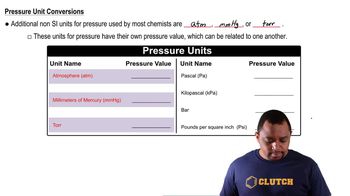
    Pressure is measured in units such as pascal (Pa), atmosphere (atm), millimeters of mercury (mmHg), torr, bar, kilopascal (kPa), and pounds per square inch (psi).
  • What are the units used to measure pressure?
    Units used to measure pressure include pascal (Pa), atmosphere (atm), mmHg, torr, bar, kPa, and psi.
  • Which one of the following is the largest value of pressure: 1 atm, 1 bar, 1 psi, or 1 mmHg?
    1 atm is the largest value among these units (1 atm = 1.01325 bar = 14.696 psi = 760 mmHg).
  • What pressure in mmHg is equivalent to 1.350 atm?
    1.350 atm is equivalent to 1,026 mmHg (1.350 × 760).
  • Why does atmospheric pressure decrease as you go higher in altitude on Earth?
    Atmospheric pressure decreases with altitude because there are fewer air molecules above you, resulting in less weight and force exerted downward.
  • What is the pressure of oxygen in normal atmospheric air?
    Oxygen makes up about 21% of atmospheric pressure, so its partial pressure is approximately 0.21 atm (160 mmHg).
  • What is the unit of measurement for pressure?
    The SI unit for pressure is the pascal (Pa), but atm, mmHg, torr, bar, and psi are also commonly used.
  • What pressure in atm is equivalent to 105.2 kPa?
    105.2 kPa is equivalent to 1.039 atm (105.2 ÷ 101.325).
  • The atmospheric pressure is 715 mm Hg. What is the pressure in torr?
    715 mm Hg is equal to 715 torr (1 mm Hg = 1 torr).
  • What is the equivalent pressure of 0.905 atm in units of mm Hg?
    0.905 atm is equivalent to 688 mm Hg (0.905 × 760).
  • What units are used to express pressure measurements?
    Pressure measurements are expressed in pascal (Pa), atmosphere (atm), mmHg, torr, bar, kPa, and psi.
  • Which of the following describes the pressure of a gas?
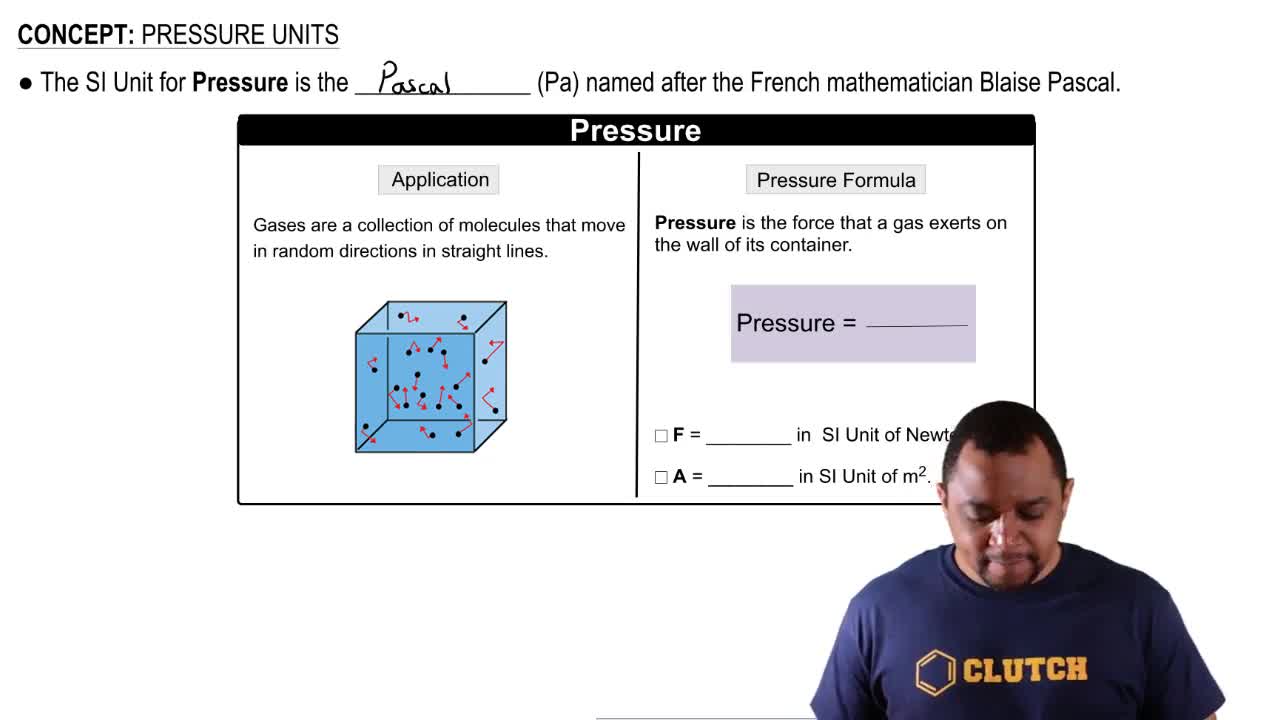
    Pressure of a gas is the force exerted by gas molecules per unit area on the walls of its container.
  • Which value of R will you use if the pressure is given in atm?
    If pressure is in atm, use R = 0.0821 L·atm/(mol·K) in the ideal gas law.
  • What units does a compound pressure gauge for the low side of the system measure pressure in?
    A compound pressure gauge typically measures pressure in psi, kPa, or bar.
  • What is the pressure at point A?
    To determine the pressure at point A, you need the specific context or measurement, but it is typically given in units such as atm, mmHg, or Pa.
  • What is pressure?
    Pressure is the force exerted per unit area, commonly by gas molecules on the walls of a container.
  • A tank of N2O has a pressure of 45.0 psi. What is this pressure in atmospheres?
    45.0 psi is equivalent to 3.06 atm (45.0 ÷ 14.696).
  • Which symbol can be used to indicate the pressure at which a chemical reaction is carried out?
    The symbol 'P' is used to indicate pressure in chemical equations.
  • What does atm stand for?
    Atm stands for atmosphere, a unit of pressure defined as 760 mmHg.
  • Which of the following is actually being measured when a vacuum is measured in microns?
    When a vacuum is measured in microns, it refers to the pressure in micrometers of mercury (μm Hg), a very low pressure.
  • What is the pressure in atm at 1400 mm Hg?
    1400 mm Hg is equivalent to 1.84 atm (1400 ÷ 760).
  • What does the constant bombardment of gas molecules against the inside walls of a container produce?
    The constant bombardment of gas molecules produces pressure inside the container.
  • What is the equivalent pressure of 968 mm Hg in units of atm?
    968 mm Hg is equivalent to 1.27 atm (968 ÷ 760).
  • If the pressure of a gas is 2.42 atm, what is its pressure in kPa?
    2.42 atm is equivalent to 245 kPa (2.42 × 101.325).
  • Solve the problem for the pressure of oxygen in kPa.
    Oxygen's partial pressure in air is about 21% of atmospheric pressure, so 0.21 × 101.325 kPa ≈ 21.3 kPa.
  • Which of the following is not a unit of pressure?
    Celsius is not a unit of pressure; it is a unit of temperature.
  • The atmospheric pressure in Denver, CO is 633 mmHg. What is this pressure in atm?
    633 mmHg is equivalent to 0.833 atm (633 ÷ 760).
  • A manometer is used to measure what?
    A manometer is used to measure the pressure of gases.
  • Convert 1.30 atm to pascals (Pa).
    1.30 atm is equivalent to 1.32 × 10^5 Pa (1.30 × 101,325).
  • Convert 2.70 atm to torr.
    2.70 atm is equivalent to 2,052 torr (2.70 × 760).
  • Rank the states on the basis of the pressure of the gas sample at each state.
    To rank the states, compare their pressure values; the state with the highest numerical value has the highest pressure.
  • A manometer is used to measure what?
    A manometer is used to measure the pressure of a gas.