Quantum Numbers: Angular Momentum Quantum Number quiz #1 Flashcards

Quantum Numbers: Angular Momentum Quantum Number quiz #1
Control buttons has been changed to "navigation" mode.
1/33
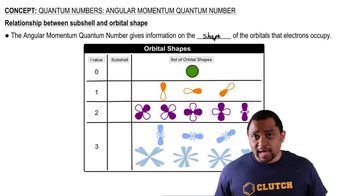
  • Which characteristic is determined by the angular momentum quantum number (l)?
    The angular momentum quantum number (l) determines the shape of an atom's orbital.
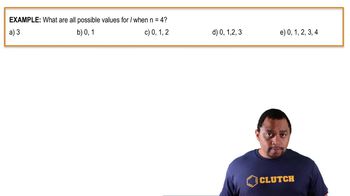
  • Which of the following gives the correct possible values of l for n = 4?
    The possible values of l for n = 4 are 0, 1, 2, and 3.
  • How many orbitals are allowed in the subshell when l = 2?
    When l = 2 (d subshell), there are 5 orbitals allowed.
  • In a ground state atom of krypton (Kr), how many electrons total will have the quantum number l = 2?
    In a ground state Kr atom, 10 electrons have l = 2 (from the 3d and 4d subshells, but only 3d is filled, so 10 electrons in 3d).
  • In a ground state atom of argon (Ar), how many electrons total will have the quantum number l = 0?
    In a ground state Ar atom, 6 electrons have l = 0 (from the 1s, 2s, and 3s subshells: 2 each).
  • How many different values of l are possible for an electron with principal quantum number n = 5?
    For n = 5, there are 5 possible values of l: 0, 1, 2, 3, and 4.
  • Which quantum number does not give information about an individual orbital?
    The principal quantum number (n) does not give information about an individual orbital; it specifies the energy level.
  • How many possible combinations are there for the values of l and ml when n = 3?
    For n = 3, there are 9 possible combinations of l and ml.
  • How many orbitals can have quantum numbers of n = 2 and l = 1?
    For n = 2 and l = 1 (2p subshell), there are 3 orbitals.
  • What is the maximum number of p orbitals that are possible in a given shell?
    There are 3 p orbitals possible in a given shell.
  • What are the possible values of l if n = 5?
    The possible values of l for n = 5 are 0, 1, 2, 3, and 4.
  • Which of the following quantum numbers describes the shape of an orbital?
    The angular momentum quantum number (l) describes the shape of an orbital.
  • For which atomic orbital does n = 3 and l = 1?
    n = 3 and l = 1 corresponds to the 3p orbital.
  • What quantum numbers specify these subshells? (For example, 2p, 3d, 4f.)
    Each subshell is specified by n (principal quantum number) and l (angular momentum quantum number): s (l=0), p (l=1), d (l=2), f (l=3).
  • Which of the following represent impossible combinations of n and l?
    Any combination where l is not in the range 0 to n-1 is impossible (e.g., n = 2, l = 2 is impossible).
  • What are the possible values of l if n = 4?
    The possible values of l for n = 4 are 0, 1, 2, and 3.
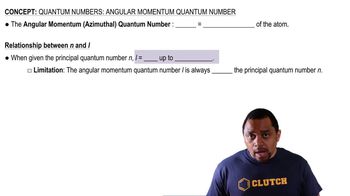
  • What are the possible values of the angular momentum quantum number l?
    For a given n, l can be any integer from 0 up to n-1.
  • What are the possible values of l for each of the following values of n?
    For n = 1: l = 0; for n = 2: l = 0, 1; for n = 3: l = 0, 1, 2; for n = 4: l = 0, 1, 2, 3.
  • How many values of the quantum number l are possible when n = 5?
    There are 5 possible values of l when n = 5: 0, 1, 2, 3, and 4.
  • How many different values of l are possible in the third principal level?
    In the third principal level (n = 3), there are 3 possible values of l: 0, 1, and 2.
  • What are the allowed values for the angular momentum quantum number l?
    The allowed values for l are integers from 0 up to n-1 for a given n.
  • What does the angular momentum quantum number determine?
    The angular momentum quantum number determines the shape of the orbital.
  • How many possible combinations are there for the values of l and ml when n = 4?
    For n = 4, there are 16 possible combinations of l and ml.
  • What type of orbital is occupied by an electron with n = 3 and l = 2?
    An electron with n = 3 and l = 2 occupies a 3d orbital.
  • How many different spatial orientations are there for f orbitals (l = 3)?
    There are 7 different spatial orientations for f orbitals (l = 3).
  • What is the full range of possible values of l for n = 3?
    For n = 3, the possible values of l are 0, 1, and 2.
  • How many p orbitals exist in one energy level (n ≥ 2) of an atom?
    There are 3 p orbitals in any energy level where n ≥ 2.
  • Which subshell letter corresponds to a spherical orbital?
    The s subshell (l = 0) corresponds to a spherical orbital.
  • What are the allowed values of l when the principal quantum number is n = 5?
    The allowed values of l for n = 5 are 0, 1, 2, 3, and 4.
  • What does the angular momentum quantum number determine in a hydrogen atom?
    In a hydrogen atom, the angular momentum quantum number determines the shape of the orbital.
  • What is the correct representation for the subshell with n = 2 and l = 1?
    The correct representation is 2p.
  • What is the correct representation for the subshell with n = 2 and l = 1?
    The correct representation is 2p.
  • What quantum numbers specify these subshells? (For example, 2p, 3d, 4f.)
    Each subshell is specified by n (principal quantum number) and l (angular momentum quantum number): s (l=0), p (l=1), d (l=2), f (l=3).