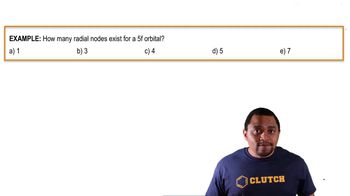
How do you determine the number of radial nodes present in a given atomic orbital?
The number of radial nodes in an orbital is calculated using the formula: radial nodes = n − l − 1, where n is the principal quantum number and l is the angular momentum quantum number.
Which orbital representation indicates that the probability of finding an electron at the nucleus is zero?
An orbital representation with a node at the nucleus, such as a p-orbital, conveys that the probability of finding an electron at the nucleus is zero.
Which types of atomic orbitals do not have a node at the nucleus?
s-orbitals do not have a node at the nucleus; their electron density is highest at the nucleus.
For the 2px orbital, how many spherical (radial) and planar (angular) nodes does it have?
The 2px orbital has 0 radial (spherical) nodes and 1 angular (planar) node.
What is the definition of a node in the context of atomic structure?
A node is a region within an atom where the probability of finding an electron is zero, meaning there is no electron density.
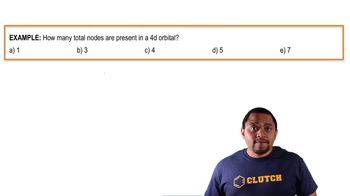
How do you calculate the total number of nodes for a given atomic orbital?
The total number of nodes is found by subtracting one from the principal quantum number: total nodes = n − 1.
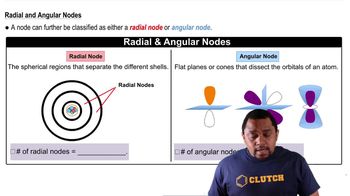
What distinguishes a radial node from an angular node in atomic orbitals?
A radial node is a spherical region separating electron shells, while an angular node is a flat plane or cone that divides orbitals.
What formula is used to determine the number of angular nodes in an atomic orbital?
The number of angular nodes is equal to the angular momentum quantum number, l.
In quantum mechanics, where are electrons most likely to be found within an atom?
Electrons are most likely to be found in electron shells, which are regions of highest probability within the atom.
Why is most of the atom considered empty space according to quantum mechanics?
Most of the atom is empty space because electrons are extremely small and occupy regions of probability rather than fixed positions.