Quantum Numbers: Principal Quantum Number quiz #1 Flashcards

Quantum Numbers: Principal Quantum Number quiz #1
Control buttons has been changed to "navigation" mode.
1/40
  • Which is a set of valid quantum numbers for an electron in an atom?
    A valid set of quantum numbers must follow the rules: n is a positive integer (≥1), l ranges from 0 to n-1, m_l ranges from -l to +l, and m_s is either +1/2 or -1/2.
  • Which characteristic is given by the principal quantum number?
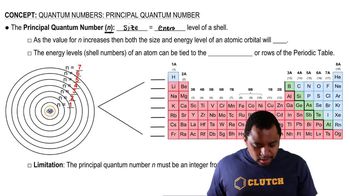
    The principal quantum number (n) determines the size and energy level of an atomic orbital.
  • What does it mean when the principal quantum number n equals 1?
    When n = 1, the electron is in the first energy level (closest to the nucleus) and the smallest shell.
  • What are the allowed values for each of the four quantum numbers: n, l, m_l, and m_s?
    n: positive integer (≥1); l: integer from 0 to n-1; m_l: integer from -l to +l; m_s: +1/2 or -1/2.
  • What does the principal quantum number indicate?
    It indicates the energy level and size of the atomic orbital.
  • Which set of quantum numbers is invalid?
    Any set where l ≥ n, m_l outside -l to +l, or m_s not ±1/2 is invalid.
  • What is the value of n for the level in which the electron originated?
    The value of n corresponds to the principal energy level from which the electron originated.
  • What does n represent in the quantum mechanical model of the atom?
    n represents the principal quantum number, which defines the energy level and size of the orbital.
  • How many different orbitals in an atom have a principal quantum number (n) of 3?
    There are 9 orbitals in the n = 3 shell.
  • Which of the following states that no two electrons can have the same set of four quantum numbers?
    The Pauli Exclusion Principle states that no two electrons in an atom can have the same set of four quantum numbers.
  • What does the principal quantum number determine?
    It determines the size and energy of the atomic orbital.
  • How many energy sublevels are in the second principal energy level?
    There are 2 sublevels in the n = 2 energy level (2s and 2p).
  • How many subshells are there in the n = 4 principal shell?
    There are 4 subshells in the n = 4 shell (4s, 4p, 4d, 4f).
  • Which energy level is the closest to the nucleus?
    The n = 1 energy level is closest to the nucleus.
  • What are the possible orbitals for n = 3?
    For n = 3, possible orbitals are 3s, 3p, and 3d.
  • What quantum numbers can apply to electrons in s orbitals?
    For s orbitals, l = 0, m_l = 0, n ≥ 1, m_s = ±1/2.
  • Which set of three quantum numbers does not specify an orbital in the hydrogen atom?
    Any set where l ≥ n or m_l outside -l to +l does not specify a valid orbital.
  • How many orbitals are contained in the third principal level (n = 3) of a given atom?
    There are 9 orbitals in the n = 3 level.
  • What is the maximum number of f orbitals that are possible in a given shell?
    There are 7 f orbitals in a given shell.
  • Which orbit has the highest energy?
    The orbital with the highest principal quantum number (n) has the highest energy.
  • How many subshells are there in the shell with n = 6?
    There are 6 subshells in the n = 6 shell.
  • For n = 4, what are the possible values of l?
    For n = 4, l can be 0, 1, 2, or 3.
  • What are the possible values of the principal quantum number n?
    n can be any positive integer starting from 1 (n = 1, 2, 3, ...).
  • Which three quantum numbers are associated with the 4d orbital?
    For a 4d orbital: n = 4, l = 2, m_l = -2, -1, 0, 1, or 2.
  • What are the allowed values for the principal quantum number n?
    Allowed values for n are positive integers (n = 1, 2, 3, ...).
  • Which of the following quantum numbers describes the size and energy of an orbital?
    The principal quantum number (n) describes the size and energy of an orbital.
  • Which one of the following sets of quantum numbers can correctly represent a 3p orbital?
    n = 3, l = 1, m_l = -1, 0, or 1, m_s = ±1/2.
  • Which set of quantum numbers is not allowed?
    Any set where l ≥ n, m_l outside -l to +l, or m_s not ±1/2 is not allowed.
  • Which set of quantum numbers is correct and consistent with n = 4?
    Any set with n = 4, l = 0 to 3, m_l = -l to +l, m_s = ±1/2 is correct.
  • Which is not a quantum number?
    Atomic mass is not a quantum number.
  • Which model of the atom explains the orbitals of electrons as waves?
    The quantum mechanical model explains electron orbitals as waves.
  • How many sublevels are in the n = 3 level?
    There are 3 sublevels in the n = 3 level (3s, 3p, 3d).
  • How many f orbitals exist in one energy level (n ≥ 4) of an atom?
    There are 7 f orbitals in an energy level where n ≥ 4.
  • What information is most important in determining the size of an orbital?
    The principal quantum number (n) is most important in determining orbital size.
  • What is the smallest possible value of the principal quantum number n for an s electron?
    The smallest possible value of n for an s electron is 1.
  • What is the smallest possible value of the principal quantum number n for an f electron?
    The smallest possible value of n for an f electron is 4.
  • How many d orbitals exist in one energy level (n ≥ 3) of an atom?
    There are 5 d orbitals in an energy level where n ≥ 3.
  • Which of the following sets of quantum numbers is not allowed?
    Any set where l ≥ n, m_l outside -l to +l, or m_s not ±1/2 is not allowed.
  • Which of the following sets of quantum numbers can describe a 4s electron?
    n = 4, l = 0, m_l = 0, m_s = ±1/2.
  • What is the smallest possible value of the principal quantum number for an electron?
    The smallest possible value of n for an electron is 1.