Quantum Numbers: Principal Quantum Number quiz #2 Flashcards

Quantum Numbers: Principal Quantum Number quiz #2
Control buttons has been changed to "navigation" mode.
1/13
  • What is the maximum number of electrons that can occupy one p orbital?
    A maximum of 2 electrons can occupy one p orbital.
  • What is the smallest possible value of the principal quantum number for an electron?
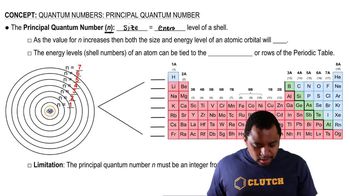
    The smallest possible value of n for an electron is 1.
  • What does the principal quantum number determine? Select all that apply.
    It determines the size and energy of the atomic orbital.
  • Which choice is a feasible set of orbital quantum numbers (n, l, m_l, m_s)?
    Any set where n ≥ 1, l = 0 to n-1, m_l = -l to +l, m_s = ±1/2 is feasible.
  • How many 8p orbitals exist?
    There are 3 8p orbitals.
  • Which types of orbitals are found in the principal energy level n = 2?
    The n = 2 level contains 2s and 2p orbitals.
  • What is the maximum number of electrons that can occupy one p orbital?
    A maximum of 2 electrons can occupy one p orbital.
  • What is the third quantum number (m_l) of a 3s2 electron in phosphorus (1s2 2s2 2p6 3s2 3p3)?
    For a 3s electron, m_l = 0.
  • Consider an electron in the state n = 4, l = 3, m_l = 2, m_s = +1/2. Is this a valid set of quantum numbers?
    Yes, this is a valid set of quantum numbers for an electron in a 4f orbital.
  • Identify the three quantum numbers for this orbital.
    The three quantum numbers are n (principal), l (angular momentum), and m_l (magnetic).
  • Select the acceptable sets of quantum numbers in an atom.
    Acceptable sets have n ≥ 1, l = 0 to n-1, m_l = -l to +l, m_s = ±1/2.
  • How many sublevels are in the n = 3 level?
    There are 3 sublevels in the n = 3 level (3s, 3p, 3d).
  • Given n = 2, identify which of the quantum numbers is not possible.
    For n = 2, l cannot be 2 or greater; m_l must be -l to +l; m_s must be ±1/2.