Which gas has molecules with the greatest average molecular speed at 25°C?
The gas with the smallest molar mass will have the greatest average molecular speed at a given temperature. At 25°C, hydrogen (H2) has the greatest average molecular speed among common gases.
Which of the following gases has the lowest average speed at 25°C?
The gas with the largest molar mass will have the lowest average speed at a given temperature. For example, among He, O2, CO2, and N2, CO2 has the lowest average speed at 25°C.
At what temperature is the root mean square velocity of H2 equal to 745 m/s?
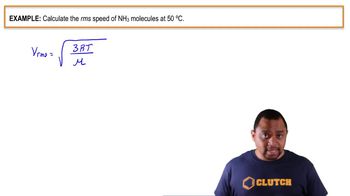
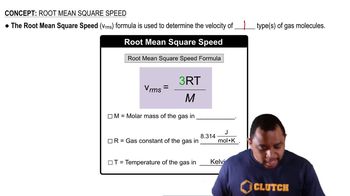
Use the RMS speed formula: v_rms = sqrt(3RT/M). Set v_rms = 745 m/s, M for H2 = 0.00202 kg/mol, and solve for T: T = (v_rms^2 × M) / (3R) = (745^2 × 0.00202) / (3 × 8.314) ≈ 44.6 K.
To what temperature must a gas be raised to triple the RMS speed of its molecules?
Since v_rms ∝ sqrt(T), to triple v_rms, temperature must be increased by a factor of 9. So, T_final = 9 × T_initial.
What is the root mean square velocity in meters per second for a nitrogen molecule (N2) at 50.0°C?
Convert 50.0°C to Kelvin: T = 323.15 K. M for N2 = 0.02801 kg/mol. v_rms = sqrt(3 × 8.314 × 323.15 / 0.02801) ≈ 517 m/s.
What is the root mean square velocity for water vapor at 300.0°C?
Convert 300.0°C to Kelvin: T = 573.15 K. M for H2O = 0.01802 kg/mol. v_rms = sqrt(3 × 8.314 × 573.15 / 0.01802) ≈ 872 m/s.
What is the root mean square velocity of O2 at 375 K?
M for O2 = 0.03200 kg/mol. v_rms = sqrt(3 × 8.314 × 375 / 0.03200) ≈ 547 m/s.
Identify the gas that has a root mean square velocity of 412 m/s at 191 K.
Rearrange the RMS formula to solve for M: M = 3RT / v_rms^2. Plug in R = 8.314, T = 191 K, v_rms = 412 m/s: M ≈ (3 × 8.314 × 191) / (412^2) ≈ 0.0281 kg/mol, which corresponds to nitrogen (N2).
Arrange the following gases in order of increasing average molecular speed at 25°C: He, O2, CO2, N2.
Order by increasing speed (largest molar mass to smallest): CO2 < O2 < N2 < He.
What is the root mean square velocity of a nitrogen molecule (N2, 28.01 g/mol) at 298 K?
M for N2 = 0.02801 kg/mol. v_rms = sqrt(3 × 8.314 × 298 / 0.02801) ≈ 517 m/s.