Skip to main content
General Chemistry
My Course
Learn
Exam Prep
AI Tutor
Study Guides
Textbook Solutions
Flashcards
Explore
Try the app
My Course
Learn
Exam Prep
AI Tutor
Study Guides
Textbook Solutions
Flashcards
Explore
Try the app
Back
Spontaneous vs Nonspontaneous Reactions definitions
You can tap to flip the card.
Spontaneity
You can tap to flip the card.
👆
Spontaneity
The natural tendency of a process to occur without continuous external energy.
Track progress
Control buttons has been changed to "navigation" mode.
1/15
Related flashcards
Related practice
Recommended videos
Spontaneous vs Nonspontaneous Reactions quiz
Spontaneous vs Nonspontaneous Reactions
10 Terms
Spontaneous vs Nonspontaneous Reactions quiz
Spontaneous vs Nonspontaneous Reactions
15 Terms
Spontaneous vs Nonspontaneous Reactions
19. Chemical Thermodynamics
3 problems
Topic
Jules
Entropy
19. Chemical Thermodynamics
6 problems
Topic
Jules
19. Chemical Thermodynamics - Part 1 of 2
5 topics
11 problems
Chapter
Jules
19. Chemical Thermodynamics - Part 2 of 2
4 topics
12 problems
Chapter
Jules
Guided course
03:05
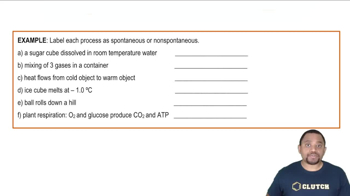
Spontaneity of Processes Example
5111
views
132
rank
1
comments
Guided course
04:20
Spontaneity of Processes
5807
views
122
rank
Terms in this set (15)
Hide definitions
Spontaneity
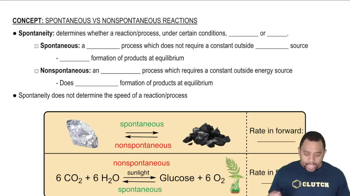
The natural tendency of a process to occur without continuous external energy.
Equilibrium
A state where reactants and products are formed at equal rates, favoring product formation in spontaneous reactions.
Thermodynamics
The study of energy changes, determining if a reaction can occur naturally.
Kinetics
The study of reaction rates, independent of whether a reaction is spontaneous.
Diamond
A form of carbon that can spontaneously convert to graphite over millions of years.
Graphite
A form of carbon that requires energy to convert into diamond, a non-spontaneous process.
Photosynthesis
A non-spontaneous process requiring sunlight to convert CO2 and water into glucose and oxygen.
Cellular Respiration
A spontaneous process converting glucose and oxygen into CO2 and water naturally.
Reactants
Substances that undergo change during a reaction, forming products in spontaneous reactions.
Products
Substances formed from reactants, favored at equilibrium in spontaneous reactions.
Energy Source
External input required for non-spontaneous reactions to proceed.
Natural Process
A process that occurs without external energy, characteristic of spontaneous reactions.
Unnatural Process
A process requiring constant external energy, characteristic of non-spontaneous reactions.
CO2
Carbon dioxide, a reactant in photosynthesis and a product in cellular respiration.
Glucose
A sugar produced in photosynthesis and consumed in cellular respiration.
 BackBack
 03:05
03:05