Strong-Field vs Weak-Field Ligands definitions Flashcards

Strong-Field vs Weak-Field Ligands definitions
Control buttons has been changed to "navigation" mode.
1/15
  • Crystal Field Splitting Energy
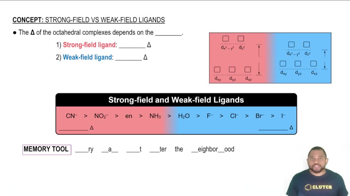
    Energy difference between lower and higher orbitals in a metal complex influenced by ligand type.
  • Octahedral Complex
    A coordination compound where a central metal atom is surrounded by six ligands.
  • Strong-Field Ligand
    Ligands that cause a large energy gap between orbitals, leading to a large crystal field splitting energy.
  • Weak-Field Ligand
    Ligands that result in a small energy gap between orbitals, causing a small crystal field splitting energy.
  • Degenerate Orbitals
    Orbitals that have the same energy level, often seen with weak-field ligands.
  • Cyanide
    A strong-field ligand known for creating the largest crystal field splitting energy.
  • Iodine
    A weak-field ligand associated with the smallest crystal field splitting energy.
  • Ethylenediamine
    A strong-field ligand that contributes to a large crystal field splitting energy.
  • Ammonia
    A strong-field ligand that increases the crystal field splitting energy.
  • Halogens
    Elements in group 7A, often weak-field ligands, ordered from fluorine to iodine.
  • Fluorine
    A halogen and weak-field ligand, part of the order from strong to weak ligands.
  • Chlorine
    A halogen and weak-field ligand, following fluorine in ligand strength.
  • Bromine
    A halogen and weak-field ligand, positioned before iodine in ligand strength.
  • Water
    A weak-field ligand that precedes halogens in the order of ligand strength.
  • Nitrate
    A strong-field ligand contributing to a large crystal field splitting energy.