What’s the difference between a proton and a positively charged hydrogen ion?
A proton is a subatomic particle with a positive charge, while a positively charged hydrogen ion (H+) is a hydrogen atom that has lost its electron, essentially becoming a proton.
Which of the following correctly pairs the particles of an atom with their physical properties? (a) Protons - negative charge (b) Neutrons - no charge (c) Electrons - positive charge
Neutrons - no charge is the correct pairing.
The nucleus of an atom is the location of which kinds of subatomic particles?
The nucleus contains protons and neutrons.
Which subatomic particle(s) are located within the nucleus of an atom?
Protons and neutrons are located within the nucleus.
Which of the following are subatomic particles?
Protons, neutrons, and electrons are subatomic particles.
What is the name of the positively charged subatomic particle?
The positively charged subatomic particle is called a proton.
Which of the following particles are found in the nucleus of an atom?
Protons and neutrons are found in the nucleus.
What part of an atom is involved in a chemical reaction: proton, neutron, nucleus, or electron?
Electrons are involved in chemical reactions.
What charge does a neutron have?
A neutron has no charge; it is neutral.
Which subatomic particle has the least mass?
The electron has the least mass.
What charge do neutrons have?
Neutrons have no charge.
Which particles do not affect the stability of the atom?
Electrons do not affect the nuclear stability of the atom.
Which of these have a positive charge and are found in the nucleus of an atom?
Protons have a positive charge and are found in the nucleus.
What kind of charge does a neutron have?
A neutron has no charge; it is neutral.
What two subatomic particles make up the center of the atom?
Protons and neutrons make up the center (nucleus) of the atom.
Which particle lies within the nucleus and carries a positive electrical charge?
The proton lies within the nucleus and carries a positive charge.
Protons are positive.
Yes, protons have a positive charge.
What three types of particles make up an atom? What are their charges?
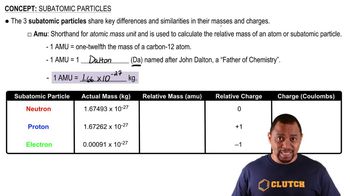
Protons (+1), neutrons (0), and electrons (-1) make up an atom.
Which subatomic particles are matched with their charges?
Protons (+1), neutrons (0), electrons (-1).
What types of particles are found in the cloud surrounding the atom’s nucleus?
Electrons are found in the cloud surrounding the nucleus.
The nucleus of most atoms is composed of which of the following sub-atomic particles?
The nucleus is composed of protons and neutrons.
What kind of charge do protons have?
Protons have a positive charge.
Which subatomic particle plays the greatest part in determining the properties of an element?
Electrons play the greatest part in determining chemical properties.
Which subatomic particle carries a negative charge?
The electron carries a negative charge.
Which subatomic particle determines the identity of the element?
The number of protons determines the identity of the element.
Which subatomic particle has the least mass? Electron, proton, neutron, or the atom?
The electron has the least mass.
Which two types of particles are present in equal numbers in an atom?
Protons and electrons are present in equal numbers in a neutral atom.
What is the negatively-charged particle in an atom?
The negatively-charged particle is the electron.
Which subatomic particle was discovered by researchers working with cathode ray tubes?
The electron was discovered by researchers using cathode ray tubes.
What are the subatomic particles that make up an atom?
Protons, neutrons, and electrons make up an atom.
Which of the following is correct concerning subatomic particles?
Protons (+1) and neutrons (0) are in the nucleus; electrons (-1) orbit the nucleus.
What is the charge of neutrons?
Neutrons have no charge.
Which particle is the least massive?
The electron is the least massive particle.
Which has the smallest mass?
The electron has the smallest mass.
Which of the following is not a fundamental subatomic particle that forms elements?
Photons are not fundamental subatomic particles in atoms.
Which part of the atom is negatively charged?
The electron cloud is negatively charged.
What is the precise mass of the proton?
The mass of a proton is approximately 1.67262 × 10⁻²⁷ kg.
Which sub-atomic particle is the smallest?
The electron is the smallest subatomic particle.
What are the charges and relative masses of the three main subatomic particles?