Hydrogen gas itself does not produce a characteristic color in a flame test; instead, it burns with a pale blue flame and may produce a 'pop' sound when ignited, indicating its presence.
What happens when iodine comes into contact with starch?
When iodine comes into contact with starch, it forms a deep blue or black color, indicating the presence of starch.
What test is used to identify the presence of hydrogen gas?
The presence of hydrogen gas is identified by the 'pop' test, where a burning splint is brought near the gas, and a popping sound confirms hydrogen.
What color flame will sodium ions (Na+) create in a flame test?
Sodium ions (Na+) produce a bright yellow flame in a flame test.
Given an image of a Benedict's test for reducing sugar, how can you tell if the result is positive or negative?
A positive Benedict's test for reducing sugar shows a color change from blue to orange, red, or green, while a negative result remains blue.
Which chemical is responsible for a positive confirmatory test for silver ions?
Silver ions are confirmed by adding chloride, bromide, or iodide ions, which form characteristic precipitates with silver nitrate.
How might a scientist identify the anion of an unknown substance?
A scientist can identify the anion by adding specific reagents and observing the formation and color of precipitates or the evolution of gases, such as using silver nitrate for halides or hydrochloric acid for carbonates.
Why is phenol red added to test tubes in chemical tests?
Phenol red is added as a pH indicator to show changes in acidity or alkalinity during chemical reactions.
What test is used to identify the presence of carbon dioxide gas?
Carbon dioxide gas is identified by bubbling it through limewater (calcium hydroxide solution), which turns cloudy if CO2 is present.
Is a chemical test typically positive or negative for the presence of a specific substance?
A chemical test can be either positive or negative, depending on whether the specific substance is present; a positive result indicates presence, while a negative result indicates absence.
Which anion will bubble (with no smell) if hydrochloric acid (HCl) is added?
Carbonate (CO3^2-) or bicarbonate (HCO3^-) ions will bubble and release odorless carbon dioxide gas when HCl is added.
 Back
Back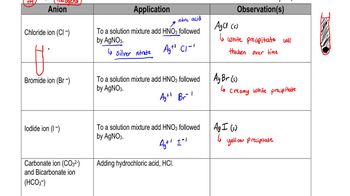
 14:42
14:42