The Atom quiz #11 Flashcards

The Atom quiz #11
Control buttons has been changed to "navigation" mode.
1/40
  • Which statement correctly describes the structure of an atom?
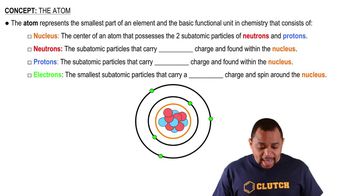
    An atom has a nucleus of protons and neutrons, surrounded by electrons.
  • How many protons does an atom of tungsten have?
    Tungsten has 74 protons.
  • What is the atomic number for an ion that has a charge of +1 and contains 18 electrons?
    The atomic number is 19 (potassium), since a +1 ion has lost one electron.
  • What is the number of protons in an atom with the electron configuration of 2-5?
    An atom with electron configuration 2-5 has 7 protons (nitrogen).
  • An atom has a mass number of 27 and 14 neutrons. What is the atomic number of this atom?
    The atomic number is 13 (mass number 27 minus 14 neutrons).
  • How many electrons are in a neutral atom of lithium?
    A neutral lithium atom has 3 electrons.
  • Which of the following determines the type of element that an atom makes?
    The number of protons determines the type of element.
  • How many protons does iodine have?
    Iodine has 53 protons.
  • Which quantity determines the identity of an atom?
    The number of protons determines the identity of an atom.
  • How many electrons does a neutral atom of lithium (Li) have?
    A neutral lithium atom has 3 electrons.
  • How many protons does lead have?
    Lead has 82 protons.
  • What is the mass number for an atom of osmium containing 76 protons and 113 neutrons?
    The mass number is 189 (76 protons + 113 neutrons).
  • What part of the atom determines an element’s identity?
    The number of protons in the nucleus determines an element's identity.
  • How do protons and electrons differ in their electric charge?
    Protons have a positive charge; electrons have a negative charge.
  • Where is the electron located?
    The electron is located in the electron cloud surrounding the nucleus.
  • How many protons are in an atom?
    The number of protons is equal to the atomic number of the atom.
  • Which statement describes the number of protons in each atom of an element?
    Each atom of an element has the same number of protons.
  • How many protons are in the nucleus of lithium (Li)?
    Lithium has 3 protons in its nucleus.
  • How many electrons are in a neutral Si atom?
    A neutral silicon atom has 14 electrons.
  • What is the charge of the nucleus of every atom?
    The nucleus of every atom is positively charged.
  • How many protons does the element cobalt (Co) have?
    Cobalt has 27 protons.
  • Which element has 13 protons?
    Aluminum has 13 protons.
  • How many protons are there in any Cl atom?
    Any chlorine atom has 17 protons.
  • What are the building blocks for all matter including solids?
    Atoms are the building blocks for all matter.
  • Which of the following describes an element?
    An element is a pure substance made of only one type of atom.
  • How many neutrons are in boron?
    Boron-11 has 6 neutrons.
  • An atom’s mass number is 210 and its atomic number is 85. How many neutrons does the atom have?
    The atom has 125 neutrons (mass number 210 minus atomic number 85).
  • How many energy levels does helium have?
    Helium has 1 energy level.
  • How many oxygen atoms are in a water molecule?
    A water molecule has 1 oxygen atom.
  • How many neutrons are there in an atom of lead whose mass number is 208?
    Lead-208 has 126 neutrons (mass number 208 minus atomic number 82).
  • What does the identity of an element depend on the number of?
    The identity of an element depends on the number of protons.
  • Which is the smallest part of an element that retains all of the properties of the element?
    An atom is the smallest part of an element that retains its properties.
  • What makes atoms electrically neutral particles?
    Atoms are electrically neutral because they have equal numbers of protons and electrons.
  • How many protons are in an atom of aluminum?
    Aluminum has 13 protons.
  • How many neutrons does a standard hydrogen atom have in its nucleus?
    A standard hydrogen atom has 0 neutrons.
  • Which is the smallest particle?
    The atom is the smallest particle of an element.
  • How many bonds can nitrogen make?
    Nitrogen typically forms 3 bonds.
  • How many energy levels are there?
    The number of energy levels depends on the atom; for example, sodium has 3.
  • What is the mass number of helium?
    The most common isotope, helium-4, has a mass number of 4.
  • How big is an atom?
    Atoms are about 0.1 to 0.5 nanometers in diameter.