Skip to main content
General Chemistry
My Course
Learn
Exam Prep
AI Tutor
Study Guides
Textbook Solutions
Flashcards
Explore
Try the app
My Course
Learn
Exam Prep
AI Tutor
Study Guides
Textbook Solutions
Flashcards
Explore
Try the app
Back
The Colligative Properties definitions
You can tap to flip the card.
Colligative Properties
You can tap to flip the card.
👆
Colligative Properties
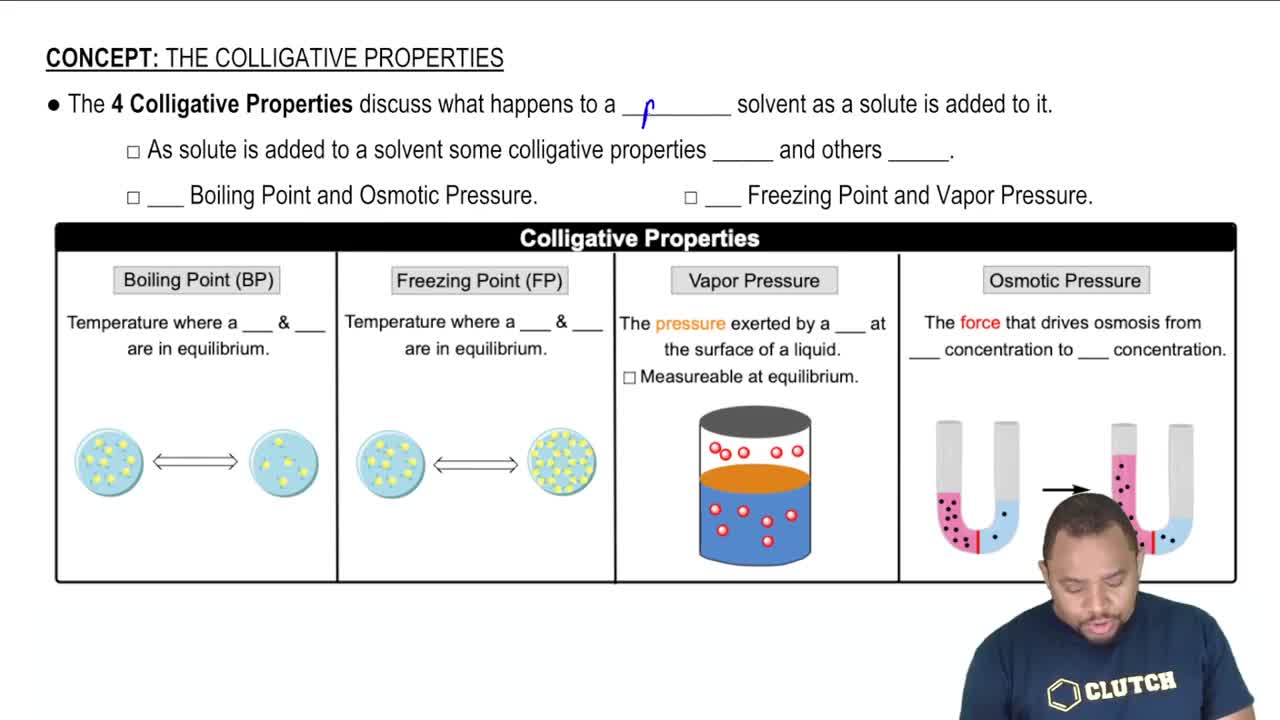
Properties of solutions that depend on the number of solute particles, not their identity.
Track progress
Control buttons has been changed to "navigation" mode.
1/15
Related flashcards
Related practice
Recommended videos
The Colligative Properties quiz #1
The Colligative Properties
12 Terms
The Colligative Properties quiz
The Colligative Properties
15 Terms
The Colligative Properties
14. Solutions
5 problems
Topic
Jules
Boiling Point Elevation
14. Solutions
4 problems
Topic
Jules
14. Solutions - Part 1 of 3
4 topics
12 problems
Chapter
Jules
14. Solutions - Part 2 of 3
5 topics
12 problems
Chapter
Jules
14. Solutions - Part 3 of 3
5 topics
12 problems
Chapter
Jules
Guided course
01:05
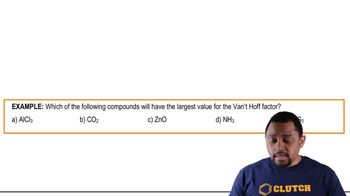
Van't Hoff Factor Example
3811
views
36
rank
Guided course
02:49
Colligative Properties
5635
views
46
rank
Guided course
02:50
Van't Hoff Factor
4478
views
38
rank
Terms in this set (15)
Hide definitions
Colligative Properties
Properties of solutions that depend on the number of solute particles, not their identity.
Boiling Point
Temperature at which a liquid's vapor pressure equals the external pressure, causing it to vaporize.
Freezing Point
Temperature at which a liquid becomes solid, with equilibrium between solid and liquid phases.
Vapor Pressure
Pressure exerted by a vapor in equilibrium with its liquid at a given temperature.
Osmotic Pressure
Force driving water movement from low to high solute concentration through a semipermeable membrane.
Van't Hoff Factor
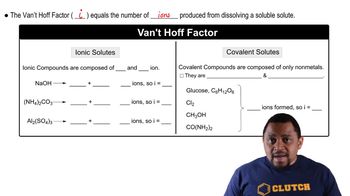
Number of particles a solute dissociates into in solution, affecting colligative properties.
Ionic Compounds
Compounds that dissociate into ions in solution, affecting colligative properties significantly.
Covalent Compounds
Non-electrolyte compounds that do not dissociate into ions in solution.
Osmolarity
Concentration of solute particles in a solution, considering ionic dissociation.
Osmolality
Concentration of solute particles per kilogram of solvent, considering ionic dissociation.
Molarity
Concentration of a solute in a solution expressed as moles per liter.
Molality
Concentration of a solute in a solution expressed as moles per kilogram of solvent.
Equilibrium
State where opposing processes occur at equal rates, maintaining a stable system.
Non-electrolytes
Substances that do not dissociate into ions in solution, typically covalent compounds.
Solute
Substance dissolved in a solvent to form a solution, affecting colligative properties.
 BackBack
 01:05
01:05