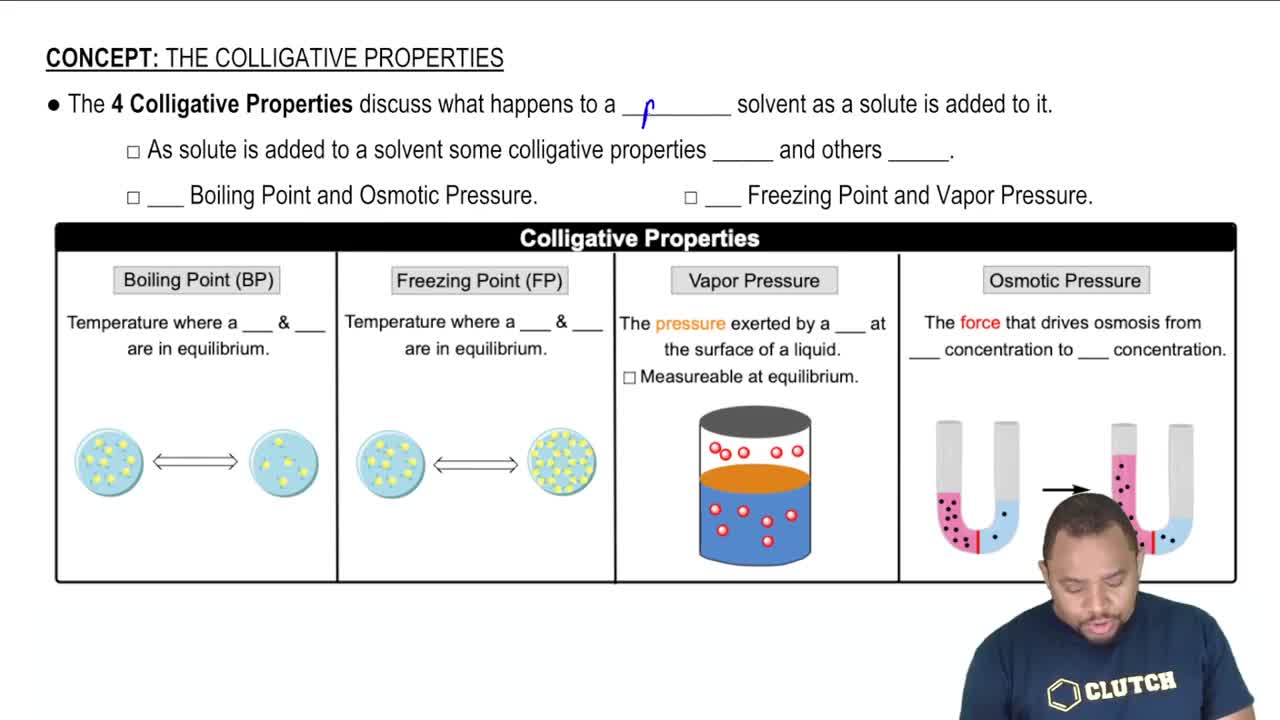
Density is not a colligative property. Colligative properties include boiling point elevation, freezing point depression, vapor pressure lowering, and osmotic pressure.
Which aqueous solution has the highest boiling point?
The aqueous solution with the highest boiling point is the one with the greatest total concentration of dissolved particles (highest osmolarity), typically an ionic compound that dissociates into multiple ions.
What property affects colligative properties?
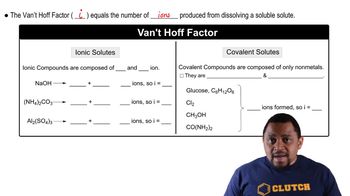
The number of dissolved particles (solute concentration and Van't Hoff factor) affects colligative properties.
What are the colligative properties?
Boiling point elevation, freezing point depression, vapor pressure lowering, and osmotic pressure are colligative properties.
What are colligative properties?
Colligative properties are solution properties that depend only on the number of dissolved particles, not their identity.
Which property is not a colligative property of a solution?
Color is not a colligative property of a solution.
What is an example of a colligative property of a solution?
Osmotic pressure is a colligative property of a solution.
What is an example of a colligative property?
Freezing point depression is an example of a colligative property.
Which characteristics are examples of colligative properties?
Boiling point elevation, freezing point depression, vapor pressure lowering, and osmotic pressure are examples of colligative properties.
What is a colligative property?
Vapor pressure lowering is a colligative property.
What are colligative properties in chemistry, and how are they affected by the addition of solute to a pure solvent?
Colligative properties are characteristics of solutions that change when a solute is added to a pure solvent. The main colligative properties are boiling point, freezing point, vapor pressure, and osmotic pressure. Adding solute increases the boiling point and osmotic pressure, while it decreases the freezing point and vapor pressure. These changes depend on the number of solute particles present, not their identity.
List the four main colligative properties and briefly describe each one.
The four main colligative properties are: (1) Boiling point, the temperature at which liquid and gas phases are in equilibrium; (2) Freezing point, the temperature at which solid and liquid phases are in equilibrium; (3) Vapor pressure, the pressure exerted by a gas at the surface of a liquid; and (4) Osmotic pressure, the force driving the movement of water from low to high solute concentration across a membrane.
 Back
Back

 01:05
01:05