Back

The Electron Configuration quiz

Control buttons has been changed to "navigation" mode.
1/15
  • What does Mendeleev's periodic law state about the arrangement of elements?

    It states that elements with similar properties recur at regular intervals when arranged by increasing atomic weight.
  • How does the periodic law influence electron configurations?

    It influences the arrangement of electrons in atoms, which affects their chemical properties and reactivity.
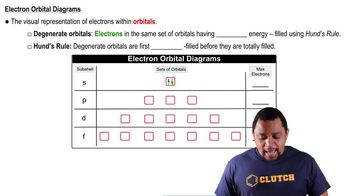
  • What is an electron orbital diagram?

    It is a visual representation of how electrons are arranged within orbitals of an atom.
  • What are degenerate orbitals?

    Degenerate orbitals are orbitals within the same subshell that have the same energy.
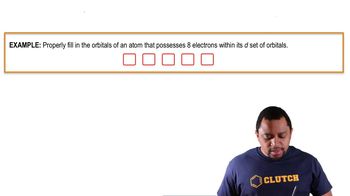
  • What does Hund's rule state about filling degenerate orbitals?

    Hund's rule states that degenerate orbitals are first half-filled with one electron each before any is completely filled.
  • How many electrons can the s, p, d, and f sublevels each hold?

    The s sublevel holds 2 electrons, p holds 6, d holds 10, and f holds 14 electrons.
  • What is the Aufbau principle?

    The Aufbau principle states that electrons fill lower energy orbitals first before moving to higher energy orbitals.
  • How does the Aufbau diagram help in writing electron configurations?

    It shows the order in which orbitals are filled, starting from 1s and moving to higher energy levels.
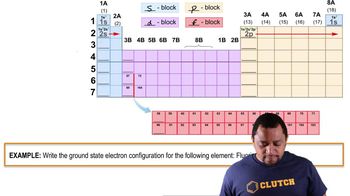
  • How is the periodic table divided based on electron configurations?

    It is divided into s, p, d, and f blocks, each corresponding to the maximum number of electrons their sublevels can hold.
  • Why does the s block of the periodic table have only two columns?

    Because the s sublevel has only one orbital, which can hold a maximum of two electrons.
  • Why does the d block start at 3d after 4s in the periodic table?

    Because after filling the 4s orbital, electrons enter the 3d orbitals, which are slightly higher in energy.
  • How many orbitals are in the p sublevel, and how are they filled according to Hund's rule?

    The p sublevel has three orbitals, and each is half-filled with one electron before any is completely filled.
  • What is the electron configuration for hydrogen and helium?

    Hydrogen is 1s1 and helium is 1s2.
  • How can the periodic table be used to determine the electron configuration of an element?

    By identifying the element's position in the s, p, d, or f block and following the order of filling orbitals as indicated by the table.
  • Why do the f blocks in the periodic table appear separated from the main table?

    Because they fit between the d blocks, representing the filling of 4f and 5f orbitals, and are shown separately for clarity.