The Electron Configurations: Exceptions quiz #1 Flashcards

The Electron Configurations: Exceptions quiz #1
Control buttons has been changed to "navigation" mode.
1/10
  • How many elements in the d block exhibit exceptions to the standard electron configurations, and which elements are they?
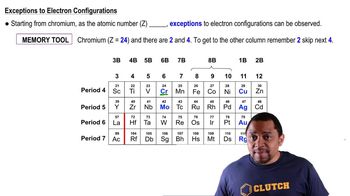
    There are six elements in the d block that commonly show exceptions to the standard electron configurations. These exceptions start with chromium (Cr) and copper (Cu), and include four additional elements in their respective groups, totaling six major exceptions.
  • What principle explains the stability of half-filled and fully-filled p and d subshells?
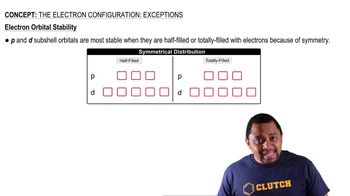
    Hund's rule explains that electrons in degenerate orbitals are most stable when half-filled or fully-filled due to symmetry.
  • Why does chromium's electron configuration differ from the expected pattern?
    Chromium promotes an electron from the 4s orbital to the 3d orbital to achieve a half-filled 3d5 configuration, which is more stable.
  • What is the actual electron configuration of copper, and why does it differ from the expected configuration?
    Copper's actual configuration is 4s1 3d10 because it promotes an electron to fully fill the d subshell, increasing stability.
  • Which atomic number marks the beginning of the d block electron configuration exceptions?
    The exceptions begin with chromium, which has an atomic number of 24.
  • What happens to the 4s electrons in elements that show electron configuration exceptions in the d block?
    One electron from the 4s orbital is promoted to the 3d orbital to achieve greater stability in these elements.
  • How does the drive for symmetry influence electron configurations in transition metals?
    The drive for symmetry leads electrons to arrange themselves so that p and d subshells are either half-filled or fully-filled, resulting in exceptions.
  • Which subshells are most affected by electron configuration exceptions due to stability concerns?
    The p and d subshells are most affected because they are more stable when half-filled or fully-filled.
  • What is the expected electron configuration for chromium before considering exceptions?
    The expected configuration is [Ar] 4s2 3d4, but this is not the most stable arrangement.
  • What is the main reason for promoting an electron from the s orbital to the d orbital in certain transition elements?
    Promoting an electron allows the d subshell to become half-filled or fully-filled, which increases the atom's stability.