The Ideal Gas Law Derivations quiz #1 Flashcards

The Ideal Gas Law Derivations quiz #1
Control buttons has been changed to "navigation" mode.
1/10
  • Which gas laws can be derived from the ideal gas law?
    Boyle's Law, Charles's Law, and Avogadro's Law can all be derived from the ideal gas law by holding certain variables constant and examining the relationships between pressure, volume, temperature, and moles.
  • What is the general form of the ideal gas law equation?
    The general form is PV = nRT, where P is pressure, V is volume, n is moles, R is the gas constant, and T is temperature.
  • When do you need to use derivations of the ideal gas law in problem solving?
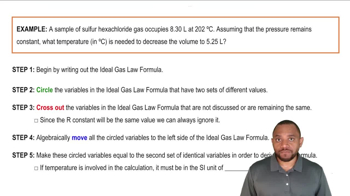
    Derivations are needed when a problem involves two sets of values for variables like pressure, volume, temperature, or moles.
  • What does the 'R' represent in the ideal gas law equation?
    R is the universal gas constant, which relates the units of pressure, volume, temperature, and moles in the equation.
  • How can you rearrange the ideal gas law to solve for temperature?
    You can rearrange it as T = PV/(nR) to solve for temperature if the other variables are known.
  • Why is it important to understand the relationships between pressure, volume, temperature, and moles in gas law problems?
    Understanding these relationships allows you to predict how changing one variable affects the others in a gas system.
  • What should you do if a question provides two pressures and two temperatures for a gas?
    You should use a derived form of the ideal gas law that relates the initial and final states, such as (P1V1)/(n1T1) = (P2V2)/(n2T2).
  • What is the significance of using the ideal gas law for scenarios with changing conditions?
    It allows for accurate calculations and predictions when a gas undergoes changes in its state variables.
  • How does the ideal gas law help in thermodynamics?
    It provides a mathematical foundation for understanding and solving problems involving the behavior of gases under different conditions.
  • What is a common mistake to avoid when applying the ideal gas law to problems with two sets of variables?
    A common mistake is not matching the correct initial and final values for each variable when setting up the derived equation.