Which question is a nonscientific question? A) How does gravity affect falling objects? B) What is the purpose of life? C) How do plants photosynthesize?
B) What is the purpose of life?
In order for a hypothesis to be used in science, it must be...
In order for a hypothesis to be used in science, it must be testable and falsifiable.
What is an example of a hypothesis?
If I increase the temperature, the solubility of sugar in water will increase.
Which is true about scientific inquiry?
Scientific inquiry involves forming hypotheses, conducting experiments, and drawing conclusions based on empirical evidence.
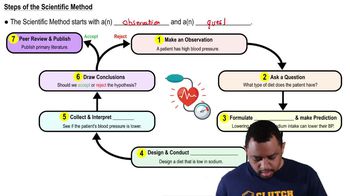
What is the proper order of the steps in the scientific method?
Observation, Hypothesis, Experiment, Conclusion
Which best describes the basic steps of the scientific method?
The basic steps of the scientific method are observation, question, hypothesis, prediction, experiment, data collection, and conclusion.
Which hypothesis is testable by using the scientific method?
Increasing the amount of sunlight will increase plant growth.
What is the best definition of a scientific theory?
A scientific theory is a well-supported explanation of a natural phenomenon based on a large body of evidence.
What is the difference between discovery-based science and hypothesis testing?
Discovery-based science involves collecting data without a preconceived hypothesis, while hypothesis testing involves experiments designed to test a specific hypothesis.
What is required of a scientific study for it to be considered a controlled experiment?
A controlled experiment requires that only one variable is changed at a time while all other variables are kept constant.
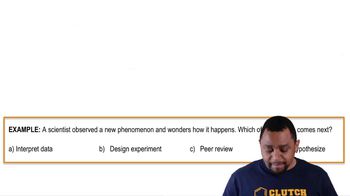
Which phase of the scientific method comes first?
The first phase of the scientific method is making an observation.
What is a false statement about a hypothesis?
It can be proven true.
Why is a control group important in an experiment?
A control group is important because it provides a baseline for comparison, ensuring that the results are due to the variable being tested.
What is a false statement regarding the scientific method?
It can prove hypotheses true.
What is a requirement that a hypothesis does not have?
It must be proven true.
Which question can be answered by following the scientific method? A) What is the meaning of life? B) How does temperature affect the rate of enzyme activity? C) Why is the sky blue?
B) How does temperature affect the rate of enzyme activity?
What is the control group in an experiment?
The control group in an experiment is the group that does not receive the experimental treatment and is used as a baseline for comparison.
Which activity is least likely to be considered a scientific experiment?
Debating the existence of ghosts
What is the difference between discovery science and hypothesis-driven science?
Discovery science involves collecting data without a preconceived hypothesis, while hypothesis-driven science involves experiments designed to test a specific hypothesis.
What best describes a scientific theory?
A scientific theory is a well-supported explanation of a natural phenomenon based on a large body of evidence.
What is true about controlled experiments?
Controlled experiments test the effect of a single variable while keeping all other variables constant.
What best describes a hypothesis?
A hypothesis is a proposed, testable explanation for an observation, predicting what and why something will happen.
What is true regarding scientific hypotheses?
Scientific hypotheses are testable and falsifiable predictions based on observations.
What best describes a controlled experiment?
A controlled experiment is one in which only one variable is changed at a time while all other variables are kept constant.
During which stage of a scientific investigation is data collected?
Data is collected during the experimentation stage of a scientific investigation.
What is part of a valid process for supporting a hypothesis?
Conducting experiments and collecting data to test the predictions made by the hypothesis is part of a valid process for supporting a hypothesis.
What is the second step of the scientific method?
The second step of the scientific method is asking a question.
What is the difference between hypothesis testing and discovery-based science?
Hypothesis testing involves experiments designed to test a specific hypothesis, while discovery-based science involves collecting data without a preconceived hypothesis.
What are the two components of science?
The two components of science are discovery-based science and hypothesis-driven science.
What is the proper order of the steps of the scientific method?
The proper order is: observation, question, hypothesis, prediction, experiment, data collection, conclusion.
What are the criteria for a good hypothesis?
A good hypothesis must be testable and falsifiable.
What is the correct order of the scientific method?
The correct order is: observation, question, hypothesis, prediction, experiment, data collection, conclusion.
Which step in the process of scientific inquiry leads to the development of a testable hypothesis?
The step of asking a question leads to the development of a testable hypothesis.
Which phrase is most likely to start a description of a scientific theory?
A scientific theory is a well-supported explanation of a natural phenomenon based on a large body of evidence.
What is the definition of a scientific theory?
A scientific theory is a well-supported explanation of a natural phenomenon based on a large body of evidence.
How does the scientific meaning of “theory” differ from the common vernacular meaning?
In science, a theory is a well-supported explanation based on evidence, while in common vernacular, it often means a guess or speculation.
What is a correct statement about the scientific method?
The scientific method is a systematic approach to research that involves observation, hypothesis formulation, experimentation, and conclusion.
 Back
Back
 00:46
00:46