Valence Electrons of Elements quiz #12 Flashcards

Valence Electrons of Elements quiz #12
Control buttons has been changed to "navigation" mode.
1/40
  • What is the number of valence electrons in cadmium (Cd)?

    Cadmium (Cd) has 12 valence electrons.
  • How many valence electrons does neon have?

    Neon has 8 valence electrons.
  • How many valence electrons does iodine have?

    Iodine has 7 valence electrons.
  • How many valence electrons do alkaline earth metals have?

    Alkaline earth metals have 2 valence electrons.
  • How many valence electrons does bromine (Br) have?

    Bromine (Br) has 7 valence electrons.
  • How many valence electrons does gallium (Ga) have?

    Gallium (Ga) has 3 valence electrons.
  • Which element has the greatest number of valence electrons available for bonding?

    Noble gases (except helium) have the greatest number of valence electrons (8), but are generally unreactive.
  • Which element has the fewest valence electrons available for bonding?

    Alkali metals have the fewest valence electrons available for bonding (1).
  • Which of the following atom(s) below has/have five valence electrons?

    Nitrogen, phosphorus, arsenic, and antimony each have five valence electrons.
  • Which of these pairs of elements have the same number of valence electrons?

    Elements in the same group, such as oxygen and sulfur, have the same number of valence electrons.
  • Which pair of elements have the same valence electronic configuration of np³?

    Nitrogen and phosphorus both have a valence configuration of np³.
  • Which element can expand its valence shell to accommodate more than eight electrons?

    Elements in period 3 and beyond (e.g., sulfur, phosphorus) can expand their valence shell.
  • Which of the following statements correctly describe valence bond theory? Select all that apply.

    Valence bond theory explains chemical bonding as the overlap of atomic orbitals containing valence electrons.
  • How many electrons are in the outermost shell of the Ga³⁺ ion in its ground state?

    Ga³⁺ has no electrons in its outermost shell.
  • Which element has a complete valence electron shell?

    Noble gases (except helium) have a complete valence electron shell.
  • In which orbitals would the valence electrons for selenium (Se) be placed?

    Selenium's valence electrons are in the 4s and 4p orbitals.
  • How many dots belong in the electron dot diagram of a boron (B) atom? Three, five, eight, or thirteen?

    Three dots belong in the electron dot diagram of boron.
  • Which of the following elements will have more than 2 electrons and have a full outer orbital?

    Noble gases (except helium) have more than 2 electrons and a full outer orbital.
  • Which of the following accurately describes properties of valence?

    Valence describes the combining capacity of an atom based on its number of valence electrons.
  • Which of the following elements has the same number of valence electrons as aluminum?

    Boron and gallium have the same number of valence electrons as aluminum (3).
  • Carbon has six protons. How many valence electrons does carbon have?

    Carbon has 4 valence electrons.
  • How many valence electrons does lithium (Li) have available for bonding? 1, 2, 3, or 4?

    Lithium has 1 valence electron available for bonding.
  • Which element has the same number of valence electrons as krypton (Kr)?

    Neon and argon have the same number of valence electrons as krypton (8).
  • Which are the valence electrons for tellurium?

    Tellurium's valence electrons are the 6 electrons in the 5s and 5p orbitals.
  • How many valence electrons does S2- have? Hint: write out the electron configuration of S2-.

    S2- has 8 valence electrons.
  • Why is the configuration of electrons in an atom’s outer shell important?

    The configuration of outer shell electrons determines chemical reactivity and bonding.
  • How many valence electrons does an iron atom (Fe) have?

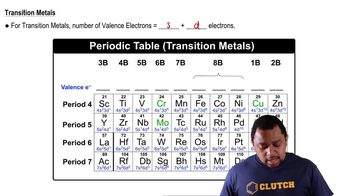
    Iron has 8 valence electrons (6 in 3d and 2 in 4s).
  • What is the significance of carbon having four valence electrons?

    Carbon can form four covalent bonds, making it versatile in chemical bonding.
  • Argon (Ar): [Ne]3s2 3p6. How many core electrons and valence electrons?

    Argon has 10 core electrons and 8 valence electrons.
  • An atom's atomic number is 7. Its valence is most likely ...

    Its valence is most likely 3 (nitrogen forms three bonds).
  • The chemical characteristics or reactivity of an element depend mostly on the __________.

    Valence electrons.
  • The chemical characteristics or reactivity of an element depend mostly on the

    Number and arrangement of valence electrons.
  • Determine the number of valence electrons in NH2OH and then draw the corresponding Lewis structure.

    NH2OH has 14 valence electrons (5 from N, 6 from O, 1 from each H).
  • The reactivity of an element can often be determined by examining the element's

    Number of valence electrons.
  • How many valence electrons do barium and phosphorus have, respectively?

    Barium has 2 valence electrons; phosphorus has 5.
  • Why is the configuration of electrons in an atom’s outer shell important?

    It determines the atom's chemical reactivity and bonding behavior.
  • Select the element(s) that will have one unpaired electron in the p orbital.

    Elements with a p1 configuration, such as boron, have one unpaired electron in the p orbital.
  • Which of the following best defines valence?

    Valence is the combining capacity of an atom based on its number of valence electrons.
  • The distance between the nucleus and the valence electrons

    The distance affects the energy and reactivity of valence electrons.
  • The valence electron of which atom in the ground state has the greatest amount of energy?

    Valence electrons in atoms with higher principal energy levels (e.g., cesium) have the greatest energy.