Skip to main content
General Chemistry
My Course
Learn
Exam Prep
AI Tutor
Study Guides
Textbook Solutions
Flashcards
Explore
Try the app
My Course
Learn
Exam Prep
AI Tutor
Study Guides
Textbook Solutions
Flashcards
Explore
Try the app
Back
Vapor Pressure Lowering (Raoult's Law) definitions
You can tap to flip the card.
Vapor Pressure
You can tap to flip the card.
👆
Vapor Pressure
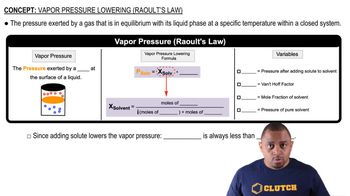
Pressure exerted by a gas in equilibrium with its liquid phase at a specific temperature in a closed system.
Track progress
Control buttons has been changed to "navigation" mode.
1/13
Related flashcards
Related practice
Recommended videos
Vapor Pressure Lowering (Raoult's Law) quiz #1
Vapor Pressure Lowering (Raoult's Law)
11 Terms
Vapor Pressure Lowering (Raoult's Law) quiz
Vapor Pressure Lowering (Raoult's Law)
15 Terms
Vapor Pressure Lowering (Raoult's Law)
14. Solutions
4 problems
Topic
Jules
Osmotic Pressure
14. Solutions
5 problems
Topic
Jules
14. Solutions - Part 1 of 3
4 topics
12 problems
Chapter
Jules
14. Solutions - Part 2 of 3
5 topics
12 problems
Chapter
Jules
14. Solutions - Part 3 of 3
5 topics
12 problems
Chapter
Jules
Guided course
02:40
Raoult's Law and Vapor Pressure
4514
views
29
rank
Guided course
02:30
Vapor Pressure Calculation Example
3772
views
19
rank
Terms in this set (13)
Hide definitions
Vapor Pressure
Pressure exerted by a gas in equilibrium with its liquid phase at a specific temperature in a closed system.
Raoult's Law
Describes how the vapor pressure of a solution is related to the mole fraction of the solvent and the pure solvent's vapor pressure.
Solvent
The component of a solution present in the greatest amount, which dissolves the solute.
Solute
The substance dissolved in a solvent to form a solution, affecting the solution's vapor pressure.
Mole Fraction
Ratio of moles of a component to the total moles in a solution, used in calculating vapor pressure.
Van't Hoff Factor
A factor representing the number of particles a solute dissociates into in a solution.
Colligative Properties
Properties of solutions that depend on the number of solute particles, not their identity.
Equilibrium
A state where the rate of vaporization equals the rate of condensation at the liquid's surface.
Condensation
The process by which a gas turns into a liquid, occurring at the liquid's surface.
Vaporization
The process by which a liquid turns into a gas, occurring at the liquid's surface.
Closed System
A system where no matter is exchanged with the surroundings, allowing equilibrium to be studied.
Pure Solvent
A solvent without any solute, used as a reference in vapor pressure calculations.
Solution
A homogeneous mixture of solute and solvent, with altered physical properties.
 BackBack
 02:40
02:40