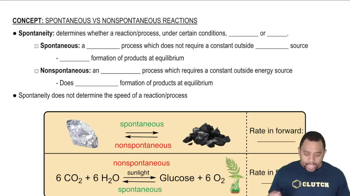
A spontaneous process occurs without ongoing outside intervention or energy input.
Is the conversion of diamond to graphite spontaneous?
Yes, because graphite is more stable than diamond, the conversion is spontaneous but occurs at a very slow rate.
What is the sign of ΔH for an endothermic process?
ΔH > 0 for an endothermic process, meaning heat is absorbed.
What is the sign of ΔH for an exothermic process?
ΔH < 0 for an exothermic process, meaning heat is released.
How does entropy (S) relate to molecular disorder?
Entropy is a thermodynamic function that increases with the number of energetically equivalent ways (microstates) to arrange a system, reflecting its degree of disorder or randomness.
State the Second Law of Thermodynamics in terms of entropy.
For any spontaneous process, the entropy of the universe increases: ΔS_universe > 0.
How does entropy change with phase transitions?
Entropy increases in the order: S(solid) < S(liquid) < S(gas).
What happens to entropy when volume increases?
When volume increases, ΔS > 0 because energy is dispersed over a larger space.
What two thermodynamic factors affect reaction spontaneity?
Change in enthalpy (ΔH) and change in entropy (ΔS) are the two main factors influencing spontaneity.
What is the relationship between ΔS_universe, ΔS_system, and ΔS_surroundings?
ΔS_universe = ΔS_system + ΔS_surroundings, and for spontaneous processes, this sum is positive.
Why is melting of ice spontaneous at temperatures above 0°C despite being endothermic?
Because the increase in entropy (ΔS) of the system favors spontaneity, overcoming the positive ΔH.
How is entropy change of surroundings related to enthalpy change of the system?
At constant pressure and temperature, ΔS_surroundings = -ΔH_system / T.
What is Gibbs free energy (ΔG) and its relation to spontaneity?
ΔG = ΔH - TΔS; a process is spontaneous if ΔG < 0, non-spontaneous if ΔG > 0, and at equilibrium if ΔG = 0.
How does temperature affect spontaneity when ΔH and ΔS have different signs?
If ΔH > 0 and ΔS > 0, reaction is spontaneous at high temperatures. If ΔH < 0 and ΔS < 0, spontaneous at low temperatures.
What is the Third Law of Thermodynamics regarding entropy?
The entropy of a perfect crystal at absolute zero (0 K) is zero: S = 0.
How does molar mass affect entropy?
Larger molar mass generally leads to larger entropy due to more energy dispersal.
How does molecular complexity affect entropy?
More complex molecules have higher entropy because they have more ways to distribute energy.
What is the formula to calculate standard entropy change (ΔS°) for a reaction?
ΔS°_rxn = Σ n_p S°_products - Σ n_r S°_reactants.
How is standard Gibbs free energy change (ΔG°_rxn) calculated?
 Back
Back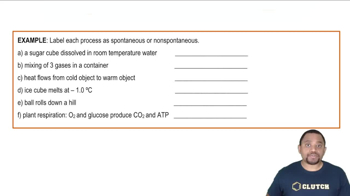
 03:05
03:05