Back

General Chemistry: Gas Laws and Kinetic Molecular Theory

Control buttons has been changed to "navigation" mode.
1/20
  • Kinetic Molecular Theory assumptions

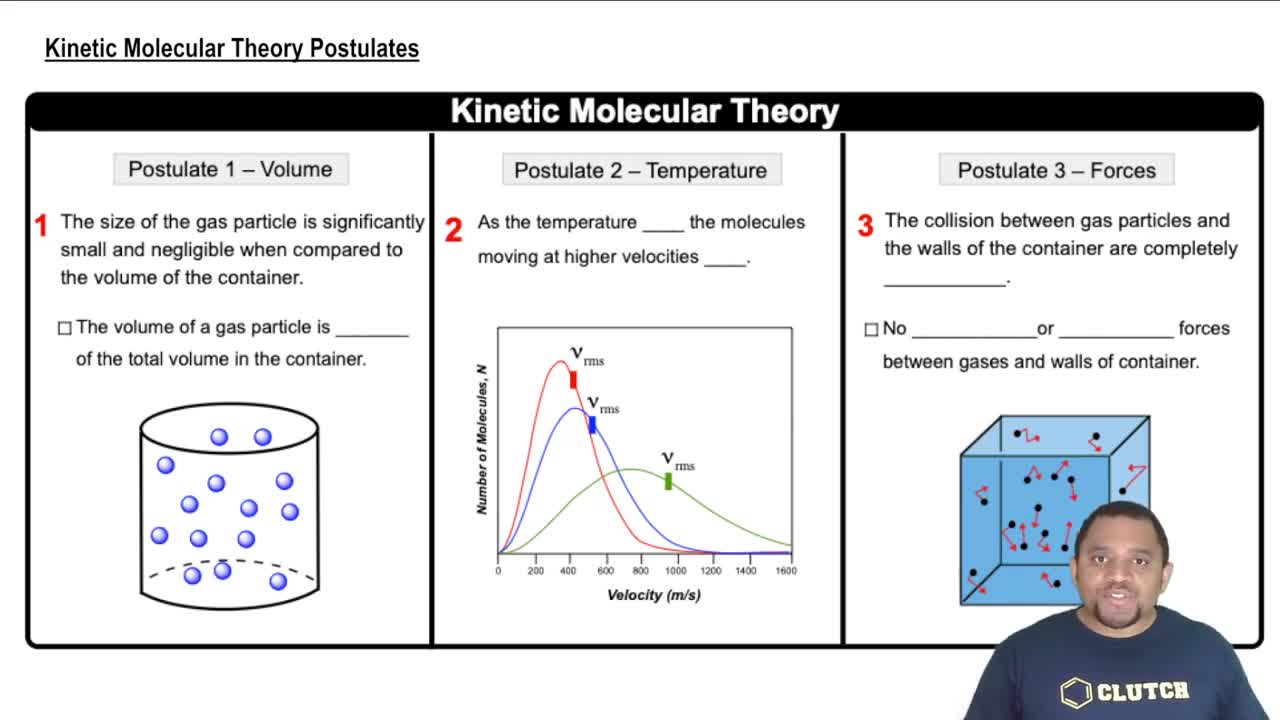
    1. No attractions or repulsions between particles; collisions like billiard ball collisions.
    2. A lot of space between particles compared to their size.
    3. Speed of particles increases with increasing temperature.
  • What causes gas pressure?

    Gas pressure results from constant collisions of gas molecules with surfaces, creating force per unit area.
  • Effect of particle density on gas pressure

    Higher density of gas particles results in higher pressure; lower density results in lower pressure.
  • How does a barometer measure atmospheric pressure?

    A barometer measures pressure by the height of a mercury column balanced by atmospheric pressure.
  • Common pressure units and equivalences

    1 atm = 760 torr = 101,325 Pa = 14.7 psi = 29.92 in Hg = 1 x 10^5 Pa
  • Boyle's Law relationship

    At constant temperature, pressure and volume are inversely proportional: \(P \times V = k\).
  • Molecular explanation of Boyle's Law

    Decreasing volume increases collision frequency of gas molecules with surfaces, increasing pressure.
  • Charles's Law relationship

    At constant pressure, volume is directly proportional to temperature in kelvins: \(\frac{V}{T} = k\).
  • Molecular view of Charles's Law

    Increasing temperature increases particle speed, causing gas volume to expand.
  • Avogadro's Law relationship

    At constant pressure and temperature, volume is directly proportional to number of moles: \(\frac{V}{n} = k\).
  • Combined Gas Law formula

    \(\frac{P_1 V_1}{T_1} = \frac{P_2 V_2}{T_2}\), relates pressure, volume, and temperature when moles are constant.
  • Ideal Gas Law formula

    \(PV = nRT\), relates pressure, volume, temperature, and moles of gas.
  • Units for Ideal Gas Constant R

    R = 0.08206 L atm / (mol K)
  • Effect of temperature on gas particle speed

    Gas particle speed increases with temperature, increasing kinetic energy.
  • Gas compressibility compared to liquids and solids

    Gases are compressible due to large spaces between particles; liquids and solids are not compressible.
  • Pressure unit Pascal (Pa) definition

    1 Pa = 1 N/m² = 1 kg m⁻¹ s⁻², force per unit area.
  • How does adding mercury in a J-tube affect gas pressure?

    Adding mercury compresses gas, increasing pressure and decreasing volume.
  • Relationship between gas volume and moles

    More gas molecules (moles) at constant P and T means larger volume.
  • How to convert pressure units: psi to mmHg

    Use conversion: psi → atm → mmHg, e.g., 132 psi = 6.82 x 10³ mmHg.
  • What happens to gas volume when temperature increases at constant pressure?

    Gas volume increases as temperature increases, per Charles's Law.