 Back
General Chemistry: Gases Properties and Gas Laws
 02:13

Terms in this set (20)
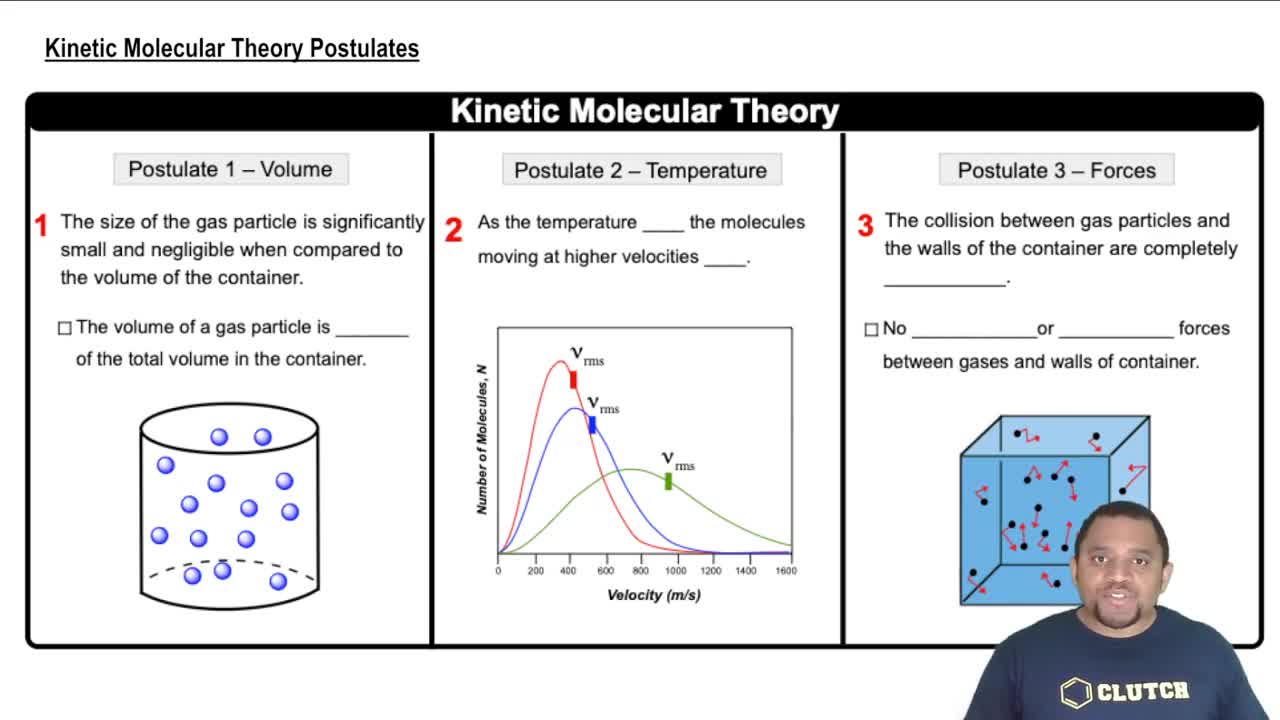
Model explaining gas behavior: particles move constantly and rapidly, collisions are elastic, particles have negligible volume, and speed increases with temperature.
Because of the large empty spaces between particles, gases can be compressed by forcing particles closer together, reducing volume.
Gas pressure results from collisions of gas particles with the walls of their container.
Pascal (Pa), pounds per square inch (psi), torr (mmHg), inches of mercury (in Hg), atmosphere (atm).
Measured in millimeters of mercury (mmHg), with systolic and diastolic values indicating different health states.
At constant temperature and moles, volume is inversely proportional to pressure: \(P_1V_1 = P_2V_2\).
Decreasing volume increases particle collisions with container walls, raising pressure.
At constant pressure and moles, volume is directly proportional to temperature in Kelvin: \(\frac{V_1}{T_1} = \frac{V_2}{T_2}\).
At constant temperature and pressure, volume is directly proportional to number of moles: \(\frac{V_1}{n_1} = \frac{V_2}{n_2}\).
Relates pressure, volume, and temperature for fixed moles: \(\frac{P_1V_1}{T_1} = \frac{P_2V_2}{T_2}\).
Combines gas laws: \(PV = nRT\), where R = 0.0821 L·atm/(mol·K).
Defined as 0°C and 1 atm; one mole of ideal gas occupies 22.4 L at STP.
Density (g/L) = Molar mass (g/mol) divided by 22.4 L.
Total pressure of a gas mixture equals the sum of partial pressures: \(P_{total} = P_1 + P_2 + ... + P_n\).
Partial pressure of component i: \(P_i = X_i \times P_{total}\), where X_i is mole fraction.
Average kinetic energy and molecular speed increase with temperature; lighter molecules move faster at the same temperature.
Diffusion is gas mixing by molecular motion; effusion is gas escape through a small hole.
Rate ratio of effusion: \(\frac{Rate_1}{Rate_2} = \sqrt{\frac{M_2}{M_1}}\), where M is molar mass.
At high pressure and low temperature, intermolecular attractions and finite particle volume cause deviations.
Modified ideal gas law: \(\left(P + a\frac{n^2}{V^2}\right)(V - nb) = nRT\), where a and b correct for attractions and volume.