 Back
BackGeneral Chemistry: Matter, Measurement, and Problem Solving
 01:34
01:34

Terms in this set (29)
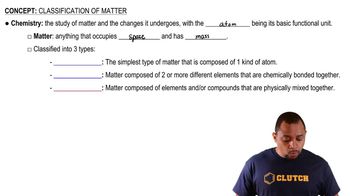
Chemistry is the study of matter, atoms and molecules, and how substances behave and change.
An atom is the basic building block of matter and the smallest unit of an element.
A molecule consists of two or more atoms chemically bonded together.
1. Observation 2. Hypothesis 3. Experimentation 4. Laws and theories
A scientific law describes what happens in nature, often as a concise statement or mathematical expression.
A scientific theory explains why or how something happens based on evidence.
Solids have fixed shape and volume with particles tightly packed in an organized structure.
Liquids have fixed volume but take the shape of their container; particles move around each other.
Gases have no fixed shape or volume; particles are far apart and move freely.
Crystalline solids have an organized repeating structure; amorphous solids have a random, non-repeating structure.
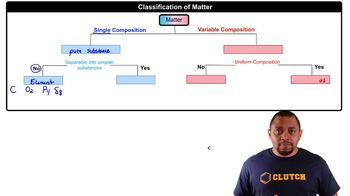
A pure substance has a fixed composition and consists of only one type of substance.
An element cannot be chemically broken down; a compound consists of two or more elements chemically bonded.
A mixture is a physical combination of two or more substances without chemical bonding.
Homogeneous mixtures are uniform throughout; heterogeneous mixtures are non-uniform.
Filtration, distillation, and decanting are common methods to separate mixtures.
A physical change alters appearance or state but does not change composition.
A chemical change changes composition and creates new substances.
Physical properties: color, density, melting point. Chemical properties: flammability, acidity.
Energy is the capacity to do work. Main types: kinetic (motion) and potential (stored) energy.
Energy cannot be created or destroyed, only transformed.
Length: meter (m), Mass: kilogram (kg), Time: second (s), Temperature: kelvin (K).
The Kelvin scale is an absolute temperature scale starting at absolute zero (0 K).
Density = mass divided by volume, \(\frac{mass}{volume}\).
Intensive properties do not depend on amount (e.g., density). Extensive properties depend on amount (e.g., mass).
Significant figures indicate the precision of a measurement.
Result has the same number of significant figures as the value with the fewest significant figures.
Result has the same number of decimal places as the value with the fewest decimal places.
Accuracy is closeness to the true value; precision is consistency among measurements.
Dimensional analysis is used for unit conversions using conversion factors and unit cancellation.