 Back
General Chemistry: Moles, Solutions, and Spectrophotometry
 1:59

Terms in this set (21)
A mole is the SI unit used to count atoms, molecules, or ions, containing exactly \(6.02214076 \times 10^{23}\) elementary entities, known as Avogadro's number.
Molar mass is the mass of one mole of an element or compound, expressed in grams per mole (g/mol). For elements, it is the atomic mass from the periodic table; for compounds, sum the atomic masses of all atoms.
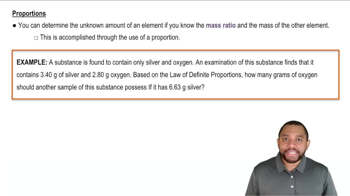
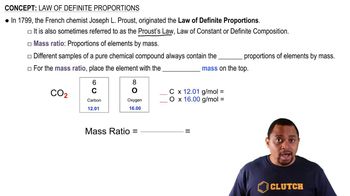
The Law of Definite Proportions states that a chemical compound always contains the same elements in exactly the same proportions by mass.
The Law of Multiple Proportions states that when two elements form more than one compound, the masses of one element that combine with a fixed mass of the other are in ratios of small whole numbers.
Percent composition is the percentage by mass of each element in a compound, calculated by dividing the mass of each element by the total mass of the compound and multiplying by 100%.
An empirical formula is the smallest whole-number ratio of atoms of each element in a compound, found by converting mass or percent to moles and simplifying the ratio.
To find the molecular formula, divide the molecular mass by the empirical formula mass, then multiply the empirical formula subscripts by this ratio.
The solute is the substance dissolved, and the solvent is the substance doing the dissolving, often water in aqueous solutions.
Strong electrolytes ionize completely and conduct electricity well; weak electrolytes partially ionize and conduct weakly; nonelectrolytes do not ionize and do not conduct electricity.
Polar solvents dissolve polar or ionic solutes (hydrophilic), and nonpolar solvents dissolve nonpolar solutes (hydrophobic).
Henry's Law states that the concentration of a dissolved gas is directly proportional to the partial pressure of the gas above the solution: \(C = kP\).
Solubility of most solids increases with temperature, but gas solubility typically decreases as temperature rises.
Unsaturated: more solute can dissolve; saturated: maximum solute dissolved; supersaturated: more solute dissolved than normal, unstable.
Molarity (M) is moles of solute per liter of solution, calculated as moles divided by volume in liters.
Dilution uses \(M_1V_1 = M_2V_2\), where moles of solute remain constant before and after dilution.
An acid is a hydrogen-containing substance that produces hydronium ions (\(H_3O^+\)) when dissolved in water.
Binary acids use the prefix 'hydro-', the root of the second element, the suffix '-ic', followed by 'acid' (e.g., HCl is hydrochloric acid).
pH is the negative base-10 logarithm of hydronium ion concentration: \(pH = -\log[H_3O^+]\).
Spectrophotometry measures how much light a colored solution absorbs or transmits at different wavelengths using a spectrophotometer.
Beer-Lambert Law relates absorbance (A) to concentration (c): \(A = \varepsilon bc\), where ε is molar absorptivity and b is path length.
Choose the wavelength at which absorbance is maximum (λmax), often the complementary color of the solution's color.