 Back
General Chemistry: The Atom and Matter
 01:34


Terms in this set (21)
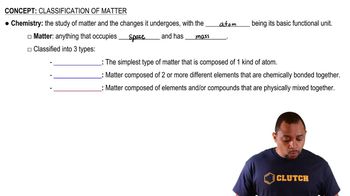
An atom is the fundamental building block of matter, consisting of protons, neutrons, and electrons.
A molecule is two or more atoms joined in a specific arrangement.
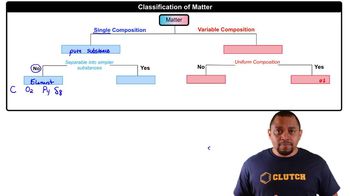
An element is a pure substance made of only one type of atom.
A compound is a pure substance composed of at least two different types of atoms chemically bonded together.
An element contains only one type of atom, while a compound contains two or more different atoms bonded together.
A mixture is a physical combination of two or more substances that retain their own properties.
Homogeneous mixtures have uniform composition; heterogeneous mixtures have visibly distinguishable parts.
The atomic number is the number of protons in an atom's nucleus.
Isotopes are atoms of the same element with the same number of protons but different numbers of neutrons.
The mass number is the total number of protons and neutrons in an atom's nucleus.
The average atomic mass is the weighted average mass of all isotopes of an element based on natural abundance.
Valence electrons are the electrons in the outermost shell of an atom that participate in chemical bonding.
The number of valence electrons corresponds to the group number in the periodic table for main-group elements.
The Bohr model describes electrons orbiting the nucleus in fixed energy levels or shells.
Electrons absorb energy to move to higher shells and release energy (as photons) when moving to lower shells.
A chemical formula uses element symbols and subscripts to show the types and relative numbers of atoms in a compound.
Charges of ions are balanced by exchanging charges to write the simplest ratio in the chemical formula.
Thomson's Plum Pudding Model proposed atoms as a positive sphere with embedded electrons.
It showed that atoms have a small, dense, positively charged nucleus with electrons dispersed around it.
The electron cloud is the region around the nucleus where electrons are likely to be found.
A cation is a positively charged ion formed by losing electrons; an anion is negatively charged by gaining electrons.