What causes the color in transition metal compounds like Cr3+, Fe2+, and Cu2+?
The color arises from electronic transitions between split d orbitals in the metal ion caused by ligand field effects.
How do transition metals form ions in terms of electron loss?
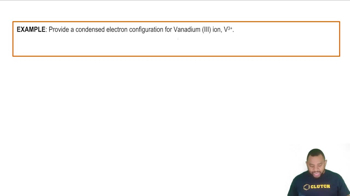
Transition metals lose their ns electrons first, then the (n-1)d electrons when forming ions.
Describe the trend in atomic radii across the first three transition metal rows.
Atomic radii are very similar across transition metals, with a small increase down a column and a small increase from the 1st to 2nd row; the 3rd row is about the same size as the 2nd due to lanthanide contraction.
How does first ionization energy change across the transition metal series?
First ionization energy generally increases across the row but less sharply than in main group elements; the 3rd row has higher ionization energies than the 1st and 2nd rows.
What is the general trend of electronegativity in transition metals?
Electronegativity generally increases across a row and from the 1st to 2nd row, with little difference between the 2nd and 3rd rows.
What is a coordination compound?
A coordination compound is a neutral compound formed by a complex ion and its counterions.
Define ligand and metal ion in coordination chemistry.
A ligand is a Lewis base that donates an electron pair; a metal ion is a Lewis acid that accepts electron pairs.
What is a coordinate covalent bond in coordination compounds?
It is the bond formed between a ligand and a metal ion where the ligand donates both electrons.
What are monodentate, bidentate, and polydentate ligands?
Monodentate ligands donate one electron pair; bidentate ligands donate two electron pairs from different atoms; polydentate ligands donate more than two electron pairs.
What is a chelate in coordination chemistry?
A chelate is a complex ion containing bidentate or polydentate ligands; the ligand is called a chelating agent.
What is the typical range of coordination numbers in complexes?
Coordination numbers typically range from 2 to 12, with odd numbers being rare.
How are coordination compounds named?
Name the cation first, then the anion; ligands are named alphabetically with prefixes for quantity; metal oxidation state is given in Roman numerals; anionic complex metals end with '-ate'.
How are neutral and anionic ligands named in complexes?
Neutral ligands use the molecule name (e.g., aqua for H2O, ammine for NH3); anionic ligands modify the ion name (e.g., -ide to -o, -ate to -ato).
What prefixes are used for multiple ligands in naming complexes?
Use di-, tri-, tetra-, etc., unless the ligand name already has a prefix, then use bis-, tris-, tetrakis-, etc.
What are coordination isomers?
Isomers where ligands and counterions exchange places between complex ions and counterions.
What are linkage isomers?
Isomers where a ligand coordinates to the metal in different ways through different atoms.
Describe cis-trans isomerism in coordination compounds.
Cis isomers have two identical ligands adjacent; trans isomers have them opposite each other.
What is fac-mer isomerism in octahedral complexes?
Facial (fac) isomers have three identical ligands adjacent forming one face; meridional (mer) isomers have them arranged in an arc around the metal.
What are optical isomers in coordination chemistry?
Non-superimposable mirror images of complexes that differ in how they rotate plane-polarized light.
What does Crystal Field Theory (CFT) explain in coordination compounds?
CFT explains the splitting of metal d orbitals in complexes, accounting for color and magnetic properties.
What is crystal field splitting energy (Δ)?
The energy difference between split d orbitals in a metal complex.
How does ligand type affect crystal field splitting energy?
Strong field ligands cause large Δ; weak field ligands cause small Δ.
How does metal cation charge affect crystal field splitting energy?
Higher metal cation charge increases Δ.
What is the difference between high-spin and low-spin complexes?
High-spin complexes have small Δ and more unpaired electrons (paramagnetic); low-spin have large Δ, fewer unpaired electrons (diamagnetic).
How do tetrahedral and square planar complexes differ in magnetic properties?
Tetrahedral complexes are usually high-spin and paramagnetic; square planar complexes are often low-spin and diamagnetic.
What are some applications of coordination compounds?
Used in metal extraction, chemical analysis, coloring agents, biomolecules (e.g., hemoglobin), and drugs (e.g., cisplatin).
What role does EDTA play in coordination chemistry?
EDTA is a hexadentate chelating agent used to bind metal ions, useful in heavy metal poisoning treatment.
What is the significance of porphyrins in biology?
Porphyrins are coordination compounds that form the basis of hemoglobin and chlorophyll, essential for oxygen transport and photosynthesis.
 Back
Back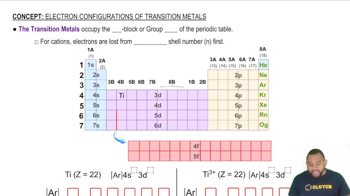
 03:12
03:12