Write balanced net ionic equations and the corresponding
equilibrium equations for the stepwise dissociation of the
triprotic acid H3PO4.
Verified step by step guidance
1
Identify the triprotic acid: H3PO4 is a triprotic acid, meaning it can donate three protons (H+ ions) in a stepwise manner.
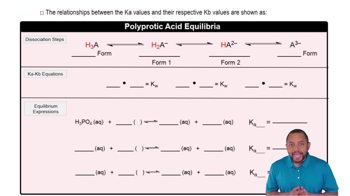
Write the first dissociation step: H3PO4 dissociates into H+ and H2PO4-. The balanced equation is: H3PO4 (aq) ⇌ H+ (aq) + H2PO4- (aq).
Write the second dissociation step: H2PO4- can further dissociate into H+ and HPO4^2-. The balanced equation is: H2PO4- (aq) ⇌ H+ (aq) + HPO4^2- (aq).
Write the third dissociation step: HPO4^2- can further dissociate into H+ and PO4^3-. The balanced equation is: HPO4^2- (aq) ⇌ H+ (aq) + PO4^3- (aq).
Combine the net ionic equations: Each step represents an equilibrium, and the net ionic equations for each step are already balanced.
Verified video answer for a similar problem:
This video solution was recommended by our tutors as helpful for the problem above.
Video duration:
9m
Play a video:
0 Comments
Key Concepts
Here are the essential concepts you must grasp in order to answer the question correctly.
Triprotic Acids
Triprotic acids, like H3PO4 (phosphoric acid), can donate three protons (H+) in a stepwise manner. Each dissociation step results in a different anion and a corresponding equilibrium constant. Understanding the nature of triprotic acids is essential for writing their dissociation equations and predicting the behavior of the resulting species in solution.
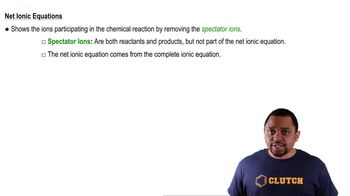
Net ionic equations represent the actual chemical species involved in a reaction, excluding spectator ions. For the dissociation of acids, this means focusing on the ions produced when the acid donates protons. Writing balanced net ionic equations is crucial for accurately depicting the chemical changes occurring in solution.
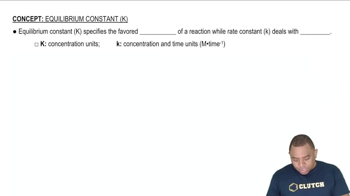
Equilibrium constants (K) quantify the ratio of products to reactants at equilibrium for a given reaction. For each step of a triprotic acid's dissociation, there is a corresponding equilibrium constant (K1, K2, K3) that reflects the strength of the acid at each dissociation stage. Understanding these constants helps in predicting the extent of dissociation and the concentrations of species in solution.


 Verified step by step guidance
 6:47
6:47