The oxalate ion is a bidentate ligand as indicated in Figure 21.8. Would you expect the carbonate ion to be a monodentate or bidentate ligand? Explain your reasoning.
Ch.21 - Transition Elements and Coordination Chemistry
Chapter 21, Problem 21.86
Which of the following complexes can exist as diastereoisomers?
(a) [Cr(NH3)2Cl4]-
(b) [Co(NH3)5Br]2+
(c) [MnCl2Br2]2- (tetrahedral)
(d) [Pt(NH3)2Br2]2-
Verified step by step guidance1
Identify the type of isomerism: Diastereoisomers are non-mirror image stereoisomers, which can occur in coordination complexes with certain geometries.
Examine the geometry of each complex: Diastereoisomerism is possible in octahedral complexes with different ligands, but not in tetrahedral complexes.
Analyze complex (a) [Cr(NH_3)_2Cl_4]^-: This is an octahedral complex with two different types of ligands, which can lead to cis-trans isomerism, a form of diastereoisomerism.
Analyze complex (b) [Co(NH_3)_5Br]^2+: This is an octahedral complex but with only one type of ligand differing, which does not allow for diastereoisomerism.
Analyze complex (d) [Pt(NH_3)_2Br_2]^2-: This is a square planar complex, which can exhibit cis-trans isomerism, a type of diastereoisomerism.

Verified video answer for a similar problem:
This video solution was recommended by our tutors as helpful for the problem above.
Key Concepts
Here are the essential concepts you must grasp in order to answer the question correctly.
Stereoisomerism
Stereoisomerism refers to the phenomenon where compounds have the same molecular formula and connectivity of atoms but differ in the spatial arrangement of those atoms. This can lead to different properties and reactivity. Diastereoisomers are a type of stereoisomer that are not mirror images of each other, which is crucial for understanding the behavior of coordination complexes.
Recommended video:
Guided course
Stereoisomers
Coordination Complexes
Coordination complexes consist of a central metal atom bonded to surrounding ligands, which can be neutral molecules or ions. The geometry of these complexes, such as octahedral or tetrahedral, influences their stereochemistry and potential for isomerism. The arrangement of ligands around the metal center is key to determining whether diastereoisomers can exist.
Recommended video:
Guided course
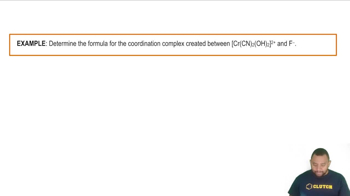
Coordination Complexes Example
Ligand Types and Their Influence
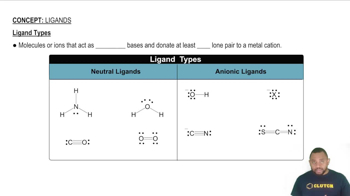
Ligands can be classified as monodentate, bidentate, or polydentate based on the number of donor atoms they use to bind to the metal center. The type and arrangement of ligands affect the symmetry and possible isomeric forms of the complex. Understanding how different ligands interact with the metal is essential for predicting the existence of diastereoisomers in coordination compounds.
Recommended video:
Guided course
Ligand Types
Related Practice
Textbook Question
108
views
Textbook Question
Although Cl- is a weak-field ligand and CN- is a strong field ligand, [CrCl6]3- and [Cr(CN)6]3- exhibit approximately the same amount of paramagnetism. Explain.
115
views
Textbook Question
What is the oxidation state of the metal in each of the complexes?
a. AgCl2–
b. [Cr(H2O)5Cl]2+
c. [Co(NCS)4]2–
d. [ZrF8]4–
e. [Fe(EDTA)(H2O)]–
89
views
Textbook Question
The glycinate anion, gly-= NH2CH2CO2 -, bonds to metal ions through the N atom and one of the O atoms. Using to represent gly-, sketch the structures of the four stereoisomers of Co(gly)3.
134
views
Textbook Question
Draw all possible diastereoisomers of [Cr(C2O4)2(H2O)2]-. Which can exist as a pair of enantiomers?
120
views
Textbook Question
Predict the number of unpaired electrons for each of the following.
(c) Zn2+
(d) Cr3+
86
views