Suggest a plausible structure for the silicate anion in the mineral thortveitite, Sc2Si2O7.
Ch.22 - The Main Group Elements
Chapter 22, Problem 22.93
What is the hybridization and geometry around carbon atoms in graphene? Explain why graphene is an excellent conductor of electricity.
Verified step by step guidance1
Graphene is a single layer of carbon atoms arranged in a two-dimensional honeycomb lattice. Each carbon atom in graphene is bonded to three other carbon atoms.
To determine the hybridization of the carbon atoms in graphene, consider the number of sigma bonds and lone pairs around each carbon. In graphene, each carbon forms three sigma bonds with neighboring carbon atoms.
The hybridization of a carbon atom with three sigma bonds and no lone pairs is \( sp^2 \). This hybridization involves the mixing of one \( s \) orbital and two \( p \) orbitals, resulting in three \( sp^2 \) hybrid orbitals.
The geometry around each carbon atom in graphene is trigonal planar, with bond angles of approximately 120 degrees. This planar structure allows for the overlap of \( p \) orbitals, forming a delocalized \( \pi \) bond system across the entire graphene sheet.
Graphene is an excellent conductor of electricity because the delocalized \( \pi \) electrons can move freely across the entire sheet, allowing for efficient charge transport. This delocalization is a result of the \( sp^2 \) hybridization and the planar geometry of the carbon atoms.

Verified video answer for a similar problem:
This video solution was recommended by our tutors as helpful for the problem above.
Was this helpful?
Key Concepts
Here are the essential concepts you must grasp in order to answer the question correctly.
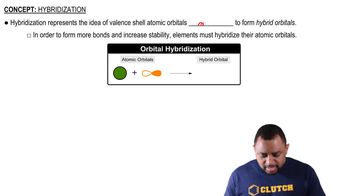
Hybridization
Hybridization is the process by which atomic orbitals mix to form new hybrid orbitals, which can explain the bonding properties of atoms in molecules. In graphene, carbon atoms undergo sp2 hybridization, where one s orbital and two p orbitals combine to create three equivalent sp2 hybrid orbitals. This arrangement allows for the formation of strong sigma bonds with neighboring carbon atoms, resulting in a planar structure.
Recommended video:
Guided course
Hybridization
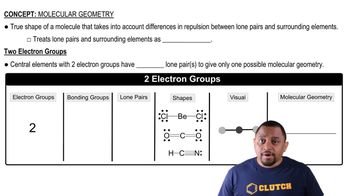
Molecular Geometry
Molecular geometry refers to the three-dimensional arrangement of atoms within a molecule. In graphene, the sp2 hybridization leads to a trigonal planar geometry around each carbon atom, with bond angles of approximately 120 degrees. This planar structure contributes to the stability and unique properties of graphene, including its high strength and flexibility.
Recommended video:
Guided course
Molecular Geometry with Two Electron Groups
Electrical Conductivity
Electrical conductivity in materials is the ability to conduct electric current, which in graphene is attributed to its delocalized π electrons. The planar structure of graphene allows these π electrons to move freely across the lattice, facilitating the flow of electricity. This property, combined with its high electron mobility, makes graphene an excellent conductor, surpassing many traditional conductive materials.
Recommended video:
Guided course
Extensive Property Example
Related Practice
Textbook Question
84
views
Textbook Question
Using the shorthand notation of Figure 22.9, draw the structure of the silicate anion in:
(a) K4SiO4 (b) Ag10Si4O13
What is the relationship between the charge on the anion and the number of terminal O atoms?
104
views
Textbook Question
Draw the electron-dot structure for CO, CO2, and CO32–, and predict which substance will have the strongest carbon–oxygen bond.
89
views
Textbook Question
Arrange the following oxides in order of increasing basic character: Al2O3, Cs2O, K2O, N2O5.
106
views
Textbook Question
Which of the following elements (X) will form a covalent hydride with the formula XH3 that is a gas at room temperature? (LO 22.4)
(a) Al (b) As (c) Ba (d) Se
97
views
Textbook Question
Give an example of an ionic carbide. What is the oxidation state of carbon in this substance?
84
views