
Ch.14 - Chemical Kinetics
Tro - Chemistry: A Molecular Approach 4th Edition
Tro4th EditionChemistry: A Molecular ApproachISBN: 9780134112831Not the one you use?Change textbook
Chapter 14, Problem 54a

This reaction was monitored as a function of time: AB → A + B A plot of 1/[AB] versus time yields a straight line with a slope of +0.55/Ms.
a. What is the value of the rate constant (k) for this reaction at this temperature?

Verified step by step guidance
1
Recognize that the plot of \( \frac{1}{[\text{AB}]} \) versus time indicates a second-order reaction.
For a second-order reaction, the integrated rate law is \( \frac{1}{[\text{AB}]} = kt + \frac{1}{[\text{AB}]_0} \), where \( k \) is the rate constant.
In the equation of a straight line \( y = mx + c \), the slope \( m \) corresponds to the rate constant \( k \) for a second-order reaction.
Given that the slope of the line is \(+0.55 \text{ M}^{-1}\text{s}^{-1}\), this value is the rate constant \( k \).
Therefore, the rate constant \( k \) for this reaction is \( 0.55 \text{ M}^{-1}\text{s}^{-1} \).

Verified video answer for a similar problem:

This video solution was recommended by our tutors as helpful for the problem above.
Video duration:
6m

Key Concepts

Here are the essential concepts you must grasp in order to answer the question correctly.

Rate Law

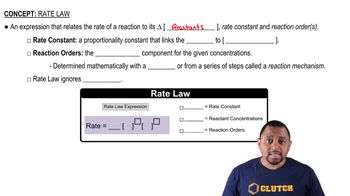
The rate law expresses the relationship between the rate of a chemical reaction and the concentration of its reactants. For a reaction of the form AB → A + B, the rate can be determined by the rate constant (k) and the concentration of AB raised to a power that reflects its order. Understanding the rate law is essential for calculating the rate constant from experimental data.
Recommended video:
Guided course
01:52
Rate Law Fundamentals

Integrated Rate Laws

Integrated rate laws relate the concentration of reactants to time. For a second-order reaction, the integrated rate law is expressed as 1/[AB] = kt + 1/[AB]₀, where k is the rate constant, t is time, and [AB]₀ is the initial concentration. The linear relationship observed in the plot of 1/[AB] versus time indicates that the reaction follows second-order kinetics.
Recommended video:
Guided course
01:52
Rate Law Fundamentals

Slope of a Line

In the context of a linear plot, the slope represents the rate constant (k) for the reaction. For the plot of 1/[AB] versus time, the slope is equal to k, which is given as +0.55/Ms in this case. This value directly provides the rate constant needed to describe the kinetics of the reaction.
Recommended video:
Guided course
01:30
Instantaneous Rate