Ch.3 - Molecules, Compounds & Chemical Equations
Tro - Chemistry: A Molecular Approach 4th Edition
Tro4th EditionChemistry: A Molecular ApproachISBN: 9780134112831Not the one you use?Change textbook
Chapter 3, Problem 66

How many molecules (or formula units) are in each sample? a. 85.26 g CCl4 b. 55.93 kg NaHCO3 c. 119.78 g C4H10 d. 4.59×10⁵ g Na3PO4

Verified step by step guidance
1
insert step 1: Identify the molar mass of each compound. For example, calculate the molar mass of CCl4 by adding the atomic masses of one carbon atom and four chlorine atoms.
insert step 2: Convert the given mass of each sample to moles using the formula: moles = mass (g) / molar mass (g/mol).
insert step 3: Use Avogadro's number (6.022 x 10^23) to convert moles to molecules or formula units. The formula is: number of molecules = moles x Avogadro's number.
insert step 4: Repeat the process for each compound: CCl4, NaHCO3, C4H10, and Na3PO4.
insert step 5: Ensure all units are consistent, especially when converting kg to g for NaHCO3, and verify calculations for accuracy.

Verified video answer for a similar problem:

This video solution was recommended by our tutors as helpful for the problem above.
Video duration:
4m

Key Concepts

Here are the essential concepts you must grasp in order to answer the question correctly.

Molar Mass

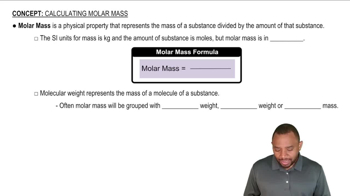
Molar mass is the mass of one mole of a substance, typically expressed in grams per mole (g/mol). It is calculated by summing the atomic masses of all atoms in a molecule. Understanding molar mass is essential for converting between grams and moles, which is necessary for determining the number of molecules in a given mass of a substance.
Recommended video:
Guided course
02:11
Molar Mass Concept

Avogadro's Number

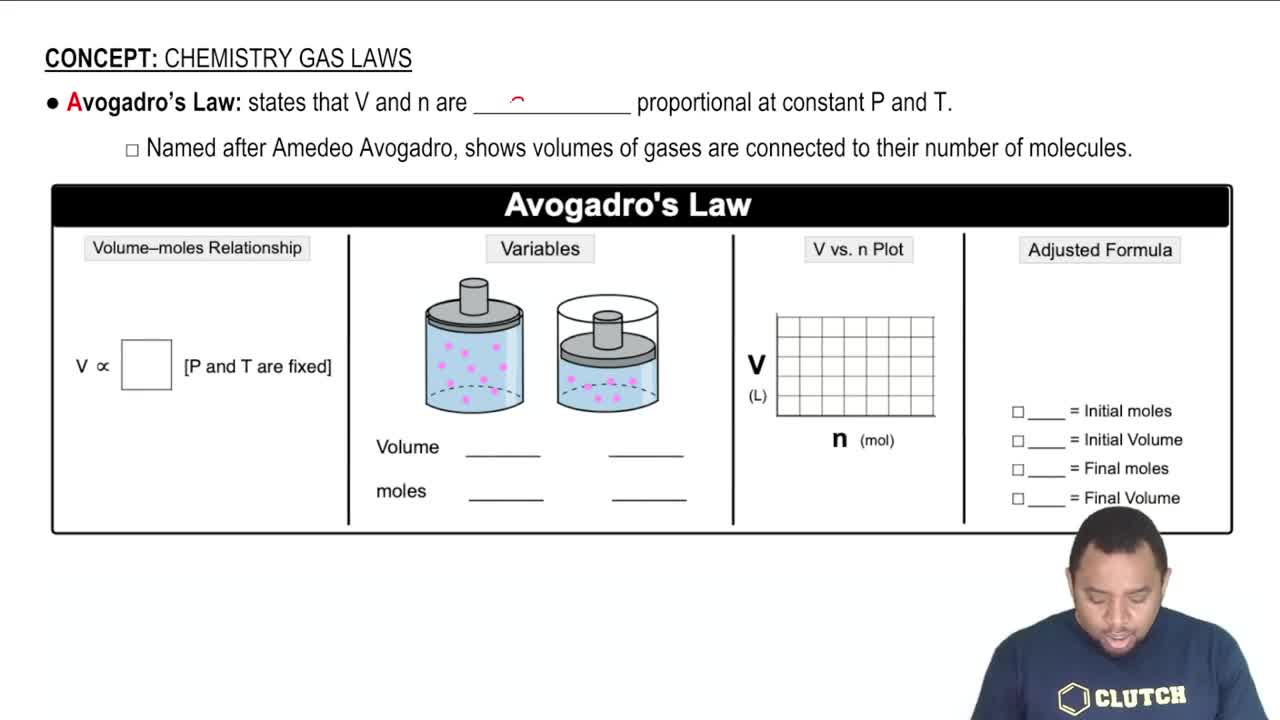
Avogadro's number, approximately 6.022 x 10^23, is the number of particles (atoms, molecules, or formula units) in one mole of a substance. This constant allows chemists to relate the macroscopic scale of substances (grams) to the microscopic scale (number of molecules), making it crucial for calculations involving the number of molecules in a sample.
Recommended video:
Guided course
02:11
Avogadro's Law

Stoichiometry

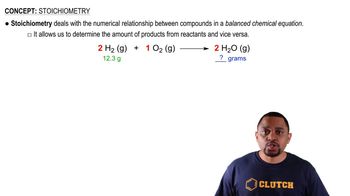
Stoichiometry is the branch of chemistry that deals with the quantitative relationships between the reactants and products in a chemical reaction. It involves using balanced chemical equations to calculate the amounts of substances involved. In the context of the question, stoichiometry helps in determining how many molecules correspond to a given mass of a compound by applying molar mass and Avogadro's number.
Recommended video:
Guided course
01:16
Stoichiometry Concept